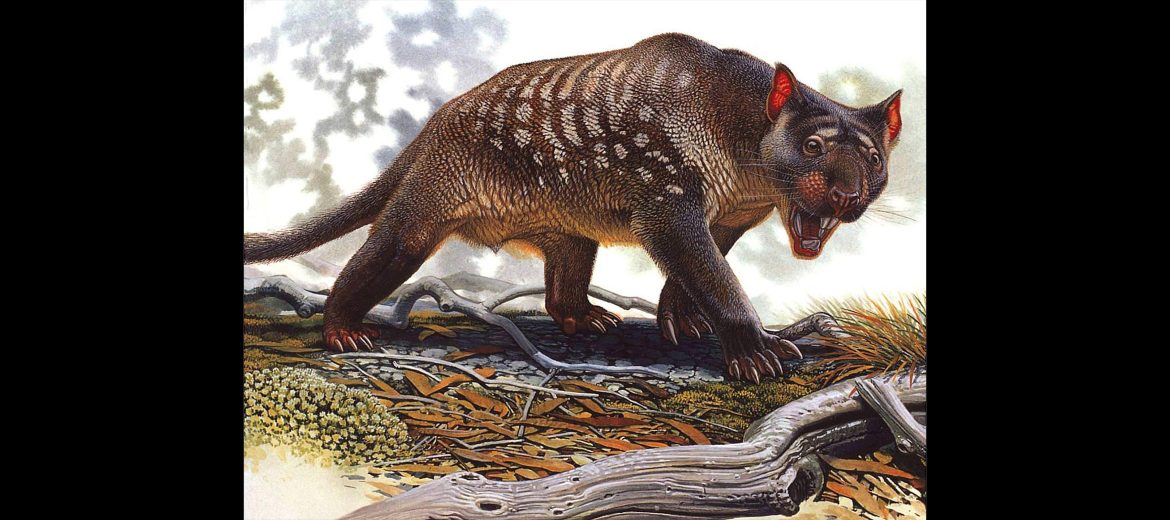
To understand what T. carnifex was eating and how it caught its prey, Flinders University palaeontologists, Dr Aaron Camens and Fraser Brown, recently surveyed more than 18,000 bones of prey animals across southern Australia. Their analyses of the bones and the bite marks they exhibited showed that T. carnifex specialised in hunting kangaroos, including extinct giant short-faced kangaroos, often disabling them with a strong bite to the ankle.
Earlier studies suggest it had one of the strongest bites of any mammal, living or extinct. It had distinctive and unique teeth with a single, long-bladed premolar instead of the separate molars and premolars seen in other mammals.
To determine the forces involved in producing the characteristic bite marks on the bones, the team collaborated with platform scientist Dr Sophie Rapagna at Microscopy Australia’s Flinders University facility and others to create a 3D-printed T. carnifex skull for testing. As a complete T. carnifex skull and jaws has never been found, they used the large volume Micro-CT scanner to scan the most complete skull and jaws that were available. Combining this data with existing scans of other near-complete skulls from the Virtual Australian Museum of Palaeontology, a complete composite scan was made and 3D printed in nylon with the teeth in steel. These materials were a good match to some of the relevant properties of bone and teeth.
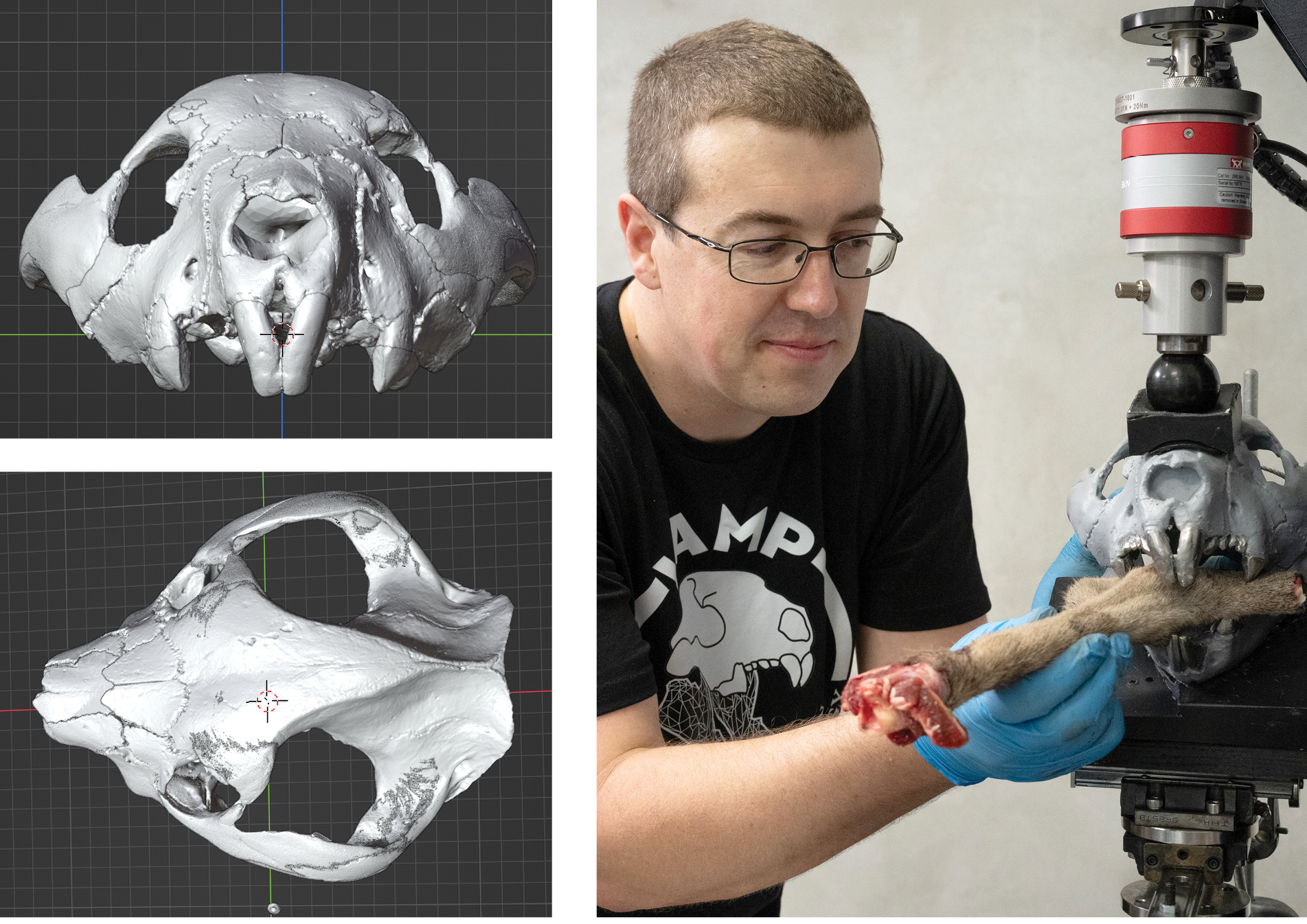
Left: A 3D reconstruction of the skull from Micro-CT scans at Microscopy Australia’s Flinders facility. Right: Dr Aaron Camens setting up the force test at ANFF with the 3D-printed skull and a kangaroo leg, photo by John Nicol.
The bite force exerted by the 3D-printed skull was then measured on kangaroo legs in the Australian National Fabrication Facility at Flinders University. They found that the force required to replicate the marks found on the fossils was much higher than they imagined. Simulations conducted by their collaborator, suggested that the force exerted could be closer to that of a crocodile.
This research was featured in the ABC documentary
Megafauna: What Killed Australia’s Giants? Watch it on ABC iview here.
Illustration of T. carnifex by Peter Schouten.
January 4, 2025