Modern science is pushing the boundaries of what’s possible at the nanoscale. One of the most ambitious goals is to create molecular robots – tiny machines built from biological materials that can perform tasks inside the body or help manufacture new materials. A promising approach is DNA origami, which uses the natural folding properties of DNA to build custom nanostructures.
However, current methods face major hurdles, including:
To truly enable advanced applications like targeted drug delivery or smart materials, researchers need a way to build complex, reconfigurable DNA nanostructures quickly and reliably.
A team at the University of Sydney Nano Institute, led by Dr Minh Tri Luu and A/Prof. Shelley Wickham, has made a breakthrough. Published in Science Robotics, they have developed modular DNA origami “voxels”—tiny building blocks that can be assembled like 3D LEGO.
Their innovation lies in a “velcro” DNA system: each voxel has programmable binding sites that only connect with matching partners through DNA base pairing. This allows for precise, high-yield assembly of diverse shapes, demonstrated by creating a nano-dinosaur, a dancing robot, and even a mini-Australia just 150 nanometres wide.
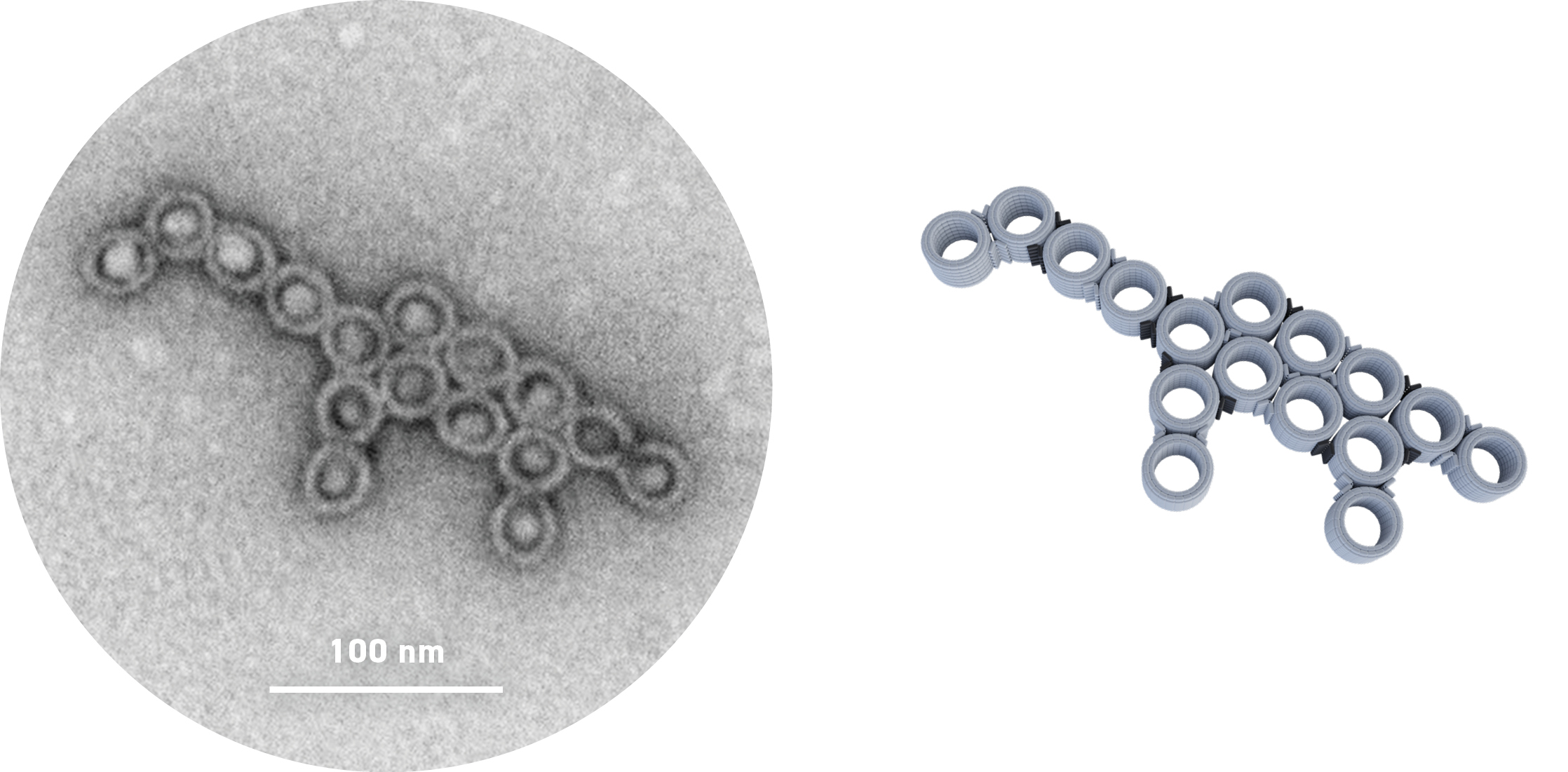
Left: Cryogenic transmission electron microscope image of the DNA origami dinosaur. It is similar in size to a typical virion – a single viral particle. Right: 3D model of DNA origami voxels (round shapes) connected into the shape of a dinosaur using programmable binding sites.
Even more impressive, these structures can be reconfigured on demand. The team demonstrated that they could switch shapes rapidly and reversibly, a key step toward adaptive molecular robots. They also developed an assembly process that increased yields by 100-fold, making previously impossible designs achievable.
This pioneering research was made possible by Microscopy Australia’s University of Sydney facility, Sydney Microscopy & Microanalysis. At only 30 nm across, the voxels are far too small to be seen with conventional microscopes. Advanced techniques, like cryo-transmission electron microscopy, were used to reveal the structure of the voxels in 3D. It was also crucial in evaluating the shape and rigidity of the voxels, and confirming design accuracy and assembly success.
This breakthrough in modular DNA origami offers a powerful new platform for building and reconfiguring nanoscale structures with speed and precision. Inspired by the principles of protein folding, the research provides fresh insight into how complex molecular systems can self-assemble, paving the way for smarter, more adaptive nanotechnologies.The potential applications are far-reaching, with the team now exploring applications from targeted drug delivery systems that minimise side effects, to smart materials that respond to their environment, and energy-efficient optical technologies. This work lays the foundation for innovations across healthcare, smart materials, and advanced manufacturing.
M. T. Luu et al., Science Robotics 2024
DOI: 10.1126/scirobotics.adp2309
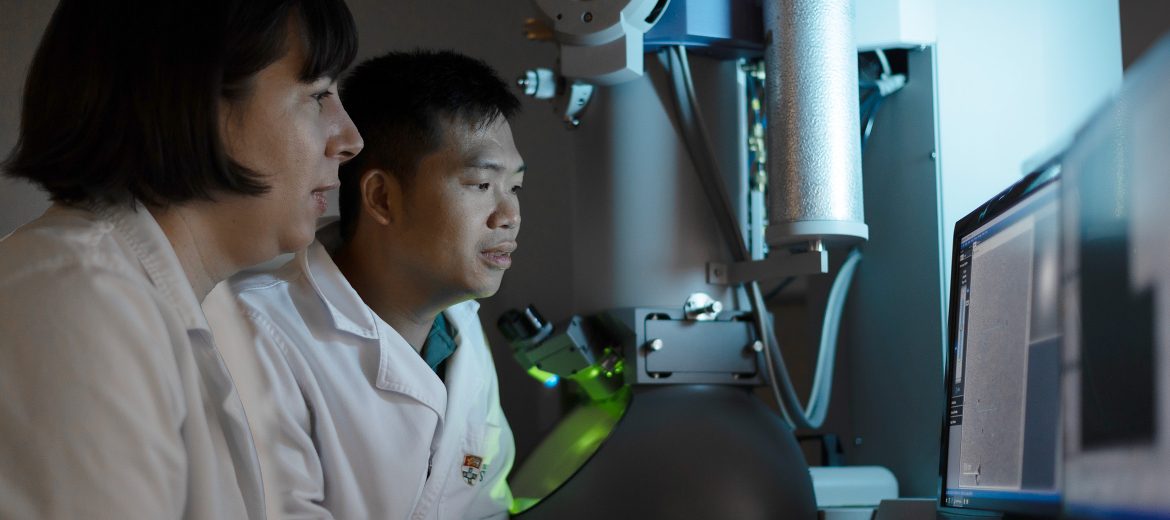
A/Prof. Shelley Wickham and Dr Minh Tri Luu using the transmission electron microscope at Microscopy Australia's University of Sydney facility © Stefanie Zingsheim, The University of Sydney
May 5, 2026