The series highlights the critical role of NCRIS-enabled capabilities in addressing major challenges across health, industry, sustainability and the economy, including Microscopy Australia, AuScope, the Australian Access Federation, National Imaging Facility and Phenomics Australia, demonstrating how shared facilities and expertise help transform ideas into impact.
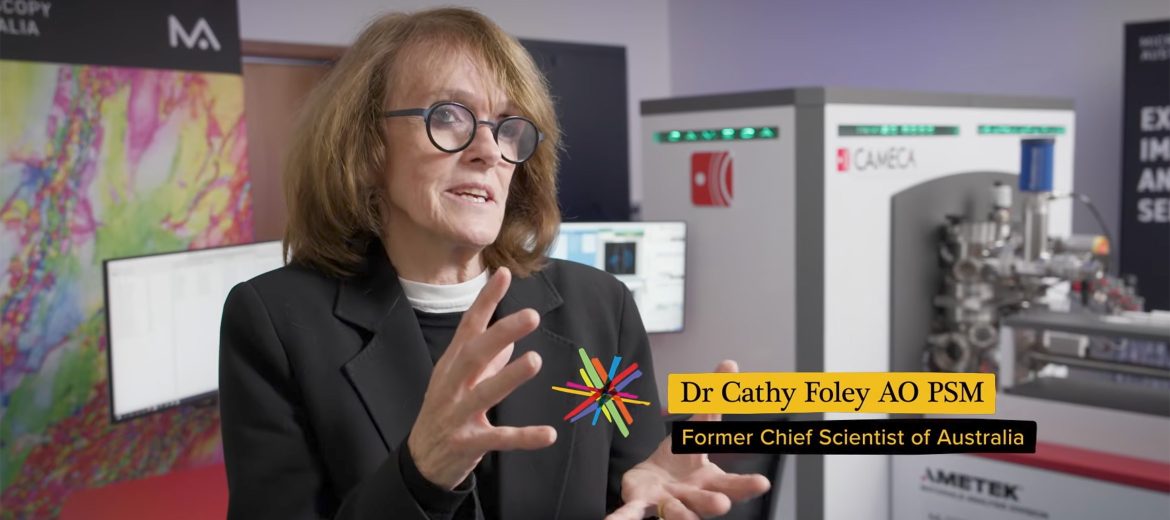
Featuring Former Chief Scientist of Australia Dr Cathy Foley, Prof. Alexandr N. Simonov, and A/Prof. Gavin Knott, Microscopy Australia’s video showcases how access to world-class microscopy facilities and expertise are enabling discoveries that can improve lives, strengthen industry and support Australia’s transition to net zero.
One of the researchers featured in the video is biologist A/Prof. Gavin Knott from Monash University, whose team is developing safer and more effective tools for gene editing and future gene therapies.
Using artificial intelligence, the team designs new molecules to control gene-editing systems. However, computer-generated designs must be validated before they can move towards clinical applications. Through cryo-electron microscopy at Microscopy Australia facilities, Professor Knott and his colleagues can directly observe biological structures at near-atomic resolution, allowing them to confirm that the molecules behave as intended.
“We used cryo-electron microscopy to prove that the molecules we dreamt in a computer actually work the way that we say they do, which is critical for translation in the clinic,” he says in the video.
The work demonstrates how advanced microscopy can bridge the gap between digital design and practical medical innovation.
Prof. Alexandr Simonov, from Monash University, is tackling one of the world’s most energy-intensive industrial processes: ammonia production for fertiliser.
Ammonia is an essential for agriculture, but conventional manufacturing relies on fossil fuels and vast quantities of electricity, currently consuming around 2% of the world’s total energy. This leaves fertiliser production vulnerable to global energy market volatility, exposing Australian farmers to price and supply shocks.
Prof. Simonov’s team are developing new electrochemical approaches that could dramatically reduce emissions while improving Australia’s fertiliser security. One of these approaches is now being commercialised by Jupiter Ionics.
Microscopy Australia plays a crucial role in helping the team understand what happens inside their systems at the nanoscale during catalytic reactions to optimise the technology’s performance. Beyond the environmental benefits, the approach could one day support local fertiliser production and reduce reliance on global supply chains, strengthening sovereign capability.
Former Chief Scientist Dr Cathy Foley highlights one of the greatest strengths of Australia’s national research infrastructure system: collaboration. Shared facilities bring together researchers from diverse disciplines who often encounter new ideas, techniques and applications through access to common instruments and expertise.
Drawing on her own experience, Dr Foley describes how advanced microscopy supported research into highly sensitive magnetic field sensors capable of detecting deeply buried mineral deposits, creating substantial economic value for Australia.
Her story illustrates how investments in research capability often produce benefits far beyond their original purpose, generating new industries, technologies and opportunities.
The stories featured in the videos showcase only a small sample of the research enabled by Australia’s national infrastructure capabilities.
Whether helping researchers develop future medical treatments, supporting cleaner industrial processes, improving agricultural resilience or uncovering new economic opportunities, facilities across the NCRIS ecosystem provide the tools and expertise that allow Australian researchers to compete on a global stage.
September 4, 2026