Despite its toxicity, average concentrations remain low. This is in part thanks to bacteria, which consume around 10–15% of this carbon monoxide annually. However, until now, the intricacies of how bacteria do this was not well understood.
New research from Monash University has solved part of this puzzle. The team revealed, at near atomic scale, how a bacterial enzyme converts carbon monoxide into energy. Led by first authors Dr Ashleigh Kropp and Dr David Gillett, with senior co-authors Prof. Chris Greening and Dr Rhys Grinter, the study revealed that a protein called CoxG acts like an energy courier, transferring power from the enzyme to the cell’s metabolic machinery.
This breakthrough was achieved using cryo-electron microscopy, which captured the enzyme’s structure in three dimensions at near-atomic resolution. The work was supported by expert platform scientist and co-author Dr Hari Venugopal at the Ramaciotti Centre for Cryo-Electron Microscopy, a Microscopy Australia facility.
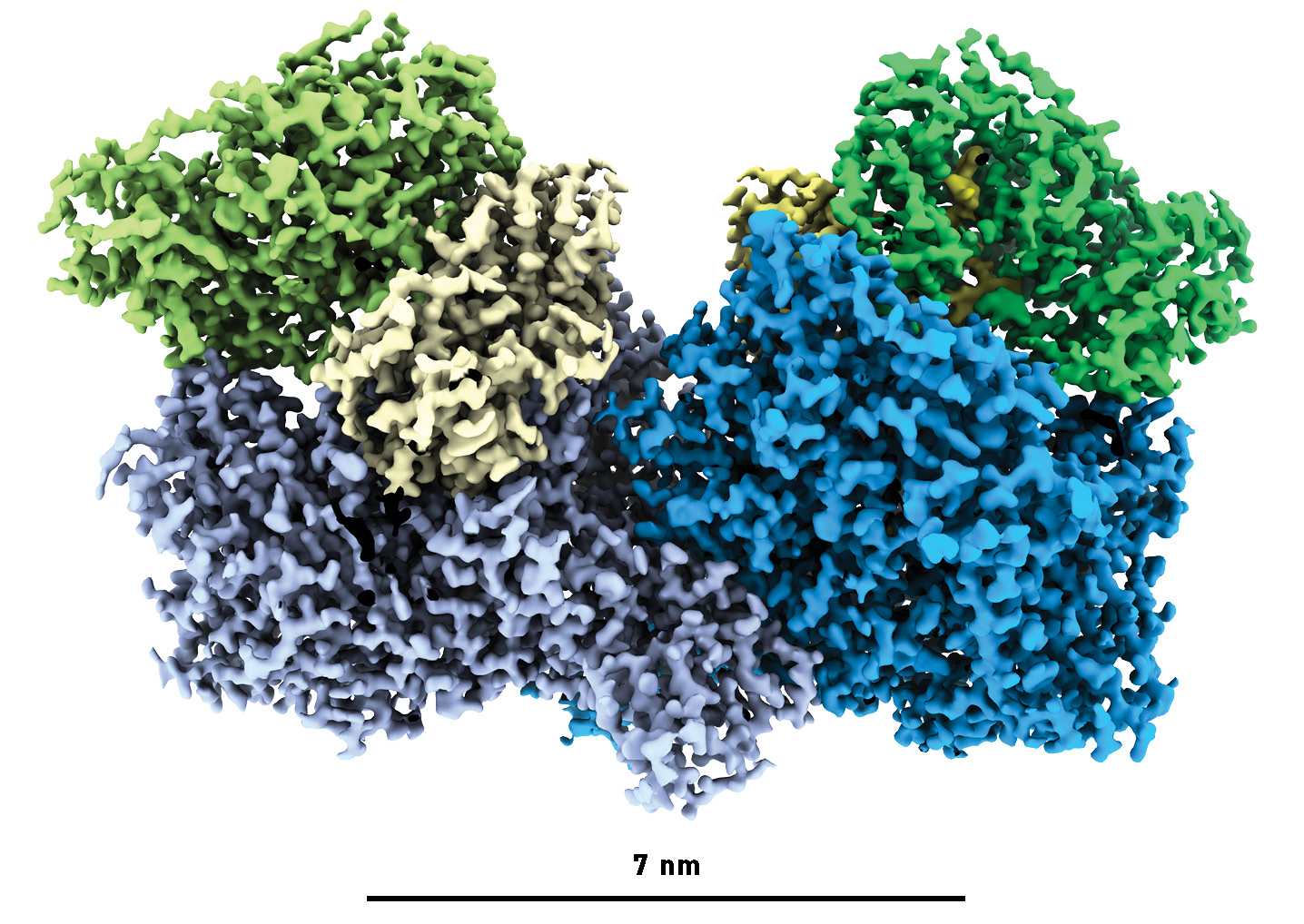
3D reconstruction of cryo electron microscope data showing the bacterial enzyme that oxidises carbon monoxide. This structure is approximately 140 hydrogen atoms wide.
The findings provide a clearer picture of how Earth’s atmosphere is regulated and underscore the vital role bacteria play in protecting human health and the environment. They also remind us how much there is still to learn about the natural systems that regulate life on Earth.
A Kropp et al., Nature Chemical Biology 2025
DOI: 10.1038/s41589-025-01836-0
May 5, 2026