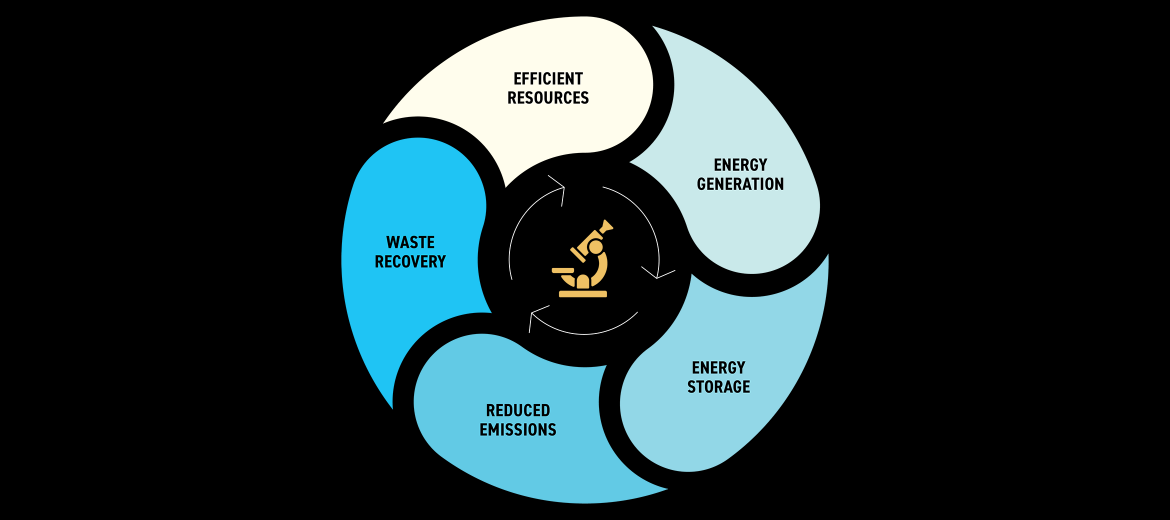
We’re not just enabling research; we’re helping to shape a greener, more sustainable future by driving innovation in renewable energy, battery technologies, natural resources and waste recovery. Here are some recent outcomes illustrating Microscopy Australia’s critical role in transitioning to a Net Zero future.
 Efficient Resources
Our facilities are used to improve exploration, refine mineral processing, reduce mining waste, and improve land remediation for gold, copper, uranium, silver, lithium and other critical minerals for start-ups up to large multi-national companies. These resources are critical for many renewable energy technologies.
Our facilities play a key role both in developing new renewable energy technologies and improving the performance, reliability and longevity of existing ones, as well as contributing to numerous solar efficiency world records.
Our facilities support the development of new technologies, performance improvement, and transport and storage infrastructure for energy storage solutions such as batteries, fuel cells, hydrogen and ammonia.
Our facilities enable continual improvements in energy efficiency to reduce carbon emissions. These include the development of new energy efficient methods and materials for ammonia and cement production, which combined account for ~10% of global CO2 emissions.
Our facilities enable advances towards a circular economy by developing ways to ensure the constant use, recycling, and regeneration of materials and products. Examples of waste recovery projects include using tyres instead of coal for steel making and extracting aluminium from coffee pods.

Samsara Eco’s unique enzymatic approach to recycling plastics gives textiles an infinite life cycle with a minimal carbon footprint. Their technology decouples plastics manufacturing from fossil fuels delivering high-quality new plastics composed of 100% recycled material.
Their optimised enzymes efficiently recycle PET and polyester plastics at scale and Samsara Eco is working to develop a wider range of enzymes to break down other plastics such as those found in textiles, soft plastics, and mixed plastics. Microscopy Australia’s facility at The Australian National University has been essential in developing their processes.
Samsara Eco raised $100M in their latest funding round while collaborator lululemon launched its first product made with enzymatically recycled polyester in July (pictured).
“Putting an end to fashion waste is critical to addressing the climate crisis… The [lululemon] Packable Anorak shows the potential to give clothes an infinite life and prevent textiles from ending up in landfills,” said Paul Riley, CEO and Founder of Samsara Eco.

ElectraLith, a spin-out from Monash University backed by Rio Tinto, is commercialising a membrane-based extraction system that filters high-quality lithium from brine, allowing the critical mineral to be extracted from salt lakes, mine tailings and other brine solutions.
ElectraLith’s method uses only small amounts of solar-generated electricity and no added chemicals or water. Eliminating the need for water is key in arid areas rich in lithium such as in Australia, Chile and Bolivia. This single-step, modular and scalable method not only provides unmatched speed and yield, but is expected to have the lowest energy requirement and environmental impact of all approaches to lithium refining.
ElectraLith was recently named the 2024 Australian Financial Review BOSS Most Innovative Company in the Agriculture, Mining, Engineering and Utilities sector. Microscopy Australia’s Monash University facility was crucial to the development of the filtration material on which the process depends.
January 4, 2025