Perovskite–silicon tandem solar cells are a next‑generation technology that could significantly improve the efficiency of solar power. By stacking two light‑absorbing materials, each tuned to different parts of the solar spectrum, tandems can convert light to electricity more efficiently than conventional silicon cells.
However, moving tandem solar cells from the lab to reliable, commercial technologies has proven difficult. A key challenge lies at the microscopic interfaces inside the device, where ultra‑thin molecular layers must form evenly and reliably to allow electrical charges to flow.
In state‑of‑the‑art devices, these layers are often made from self‑assembled monolayers (SAM). While effective in principle, SAM molecules can clump together in solution before they are deposited, leading to patchy coverage, energy losses, and reduced stability. These hidden defects at the nanoscale can undermine both performance and long‑term reliability, making it difficult to meet industry standards for solar modules.
A team led by Prof. Anita Ho‑Baillie from the University of Sydney addressed this problem by looking closely at how SAM molecules behave before they ever reach the solar cell. Reported in Joule, the researchers showed that the acidity of the SAM solution is a critical but previously under‑appreciated factor controlling whether molecules remain evenly dispersed or aggregate into clumps.
By carefully adjusting the acidity using a newly designed molecule, the team prevented aggregation and created a far more uniform molecular layer. This, in turn, improved how electrical charges moved across the interface between layers in the solar cell.
Using this approach, the team demonstrated a certified 29.1% conversion efficient perovskite–silicon tandem solar cell. It also improved stability, with solar cells retaining ≥95% of their efficiencies after more than 1,000 thermal cycles, and 26 humidify freeze cycles exceeding the minimum requirements for those tests specified by the international IEC61215 standard.

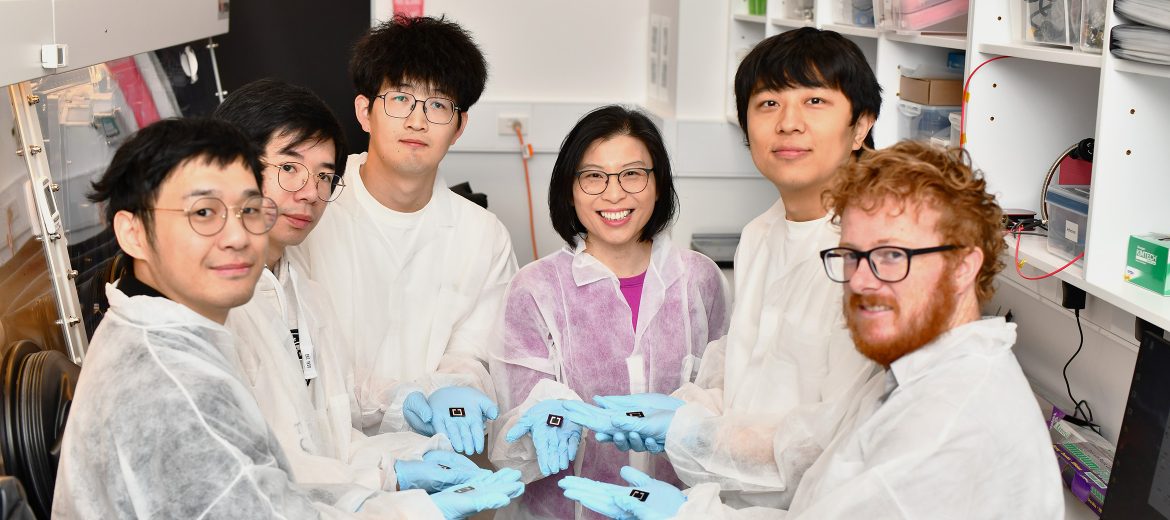
The solar cells developed by Prof. Ho-Baillie’s team at the University of Sydney
Advanced microanalysis was essential to prove how and why this approach worked. Ultraviolet photoelectron spectroscopy was used to measure changes in electronic energy levels at the interface, providing direct evidence that the chemistry tweak improved energy alignment and transport, helping charges flow more efficiently through the device.
These measurements were carried out with expert support from Dr Alex Cavallaro at Adelaide Microscopy, part of Microscopy Australia, in collaboration with A/Prof. Matthew Griffith and colleagues at Adelaide University. Device fabrication was supported by the Australian National Fabrication Facility (ANFF). Together, access to these advanced microanalysis and fabrication capabilities was enabled through Australia’s National Collaborative Research Infrastructure Strategy (NCRIS).
This work shows that small, practical changes in chemistry can unlock major gains in renewable energy technology. By improving both efficiency and durability, the research brings perovskite–silicon tandem solar cells closer to commercial deployment. More broadly, the findings provide a blueprint for designing more reliable high‑performance solar technologies, supporting the global transition to cleaner, more efficient energy systems.
Read more about how Microscopy Australia has supported Prof. Ho-Baillie’s research here.
R. Tao et al., Joule 2026
DOI: 10.1016/j.joule.2025.102314
Members of the Solar Research Group with their improved solar cell (L-R): Runmin Tao, Dr Tik Lun Peter Leung, Dr Guoliang Wang, Prof. Anita Ho-Baillie, Guang Cao and Dr Christopher G. Bailey
October 15, 2026