The transition to Net Zero requires more of metals such as copper, rare earth elements and cobalt than are currently available from known types of mineral deposits, so new sources need to be found. The more we know about the different ways in which these minerals might be formed, the more likely it is that we can find new sources that may not yet have been explored.
New results from researchers at the Australian National University (ANU), Macquarie University and the University of Western Australia, with international collaborators, predict probable locations for critical minerals: essential for the metals that enable a green economy.
Published in Nature, their most recent findings identified that critical metals appear to accumulate close to the edges of dense, heavy parts of the continental crust called cratons. This builds on earlier work from ANU, Geoscience Australia, and collaborators at Cambridge and Harvard Universities.
Molten rock (‘melts’) in the Earth’s mantle flows upwards and outwards around the edges of these cratons towards the surface, making volcanic activity more common there.
As part of an ARC Laureate program, led by Prof. Stephen Foley with the assistance of Dr Chunfei Chen, lab-based high pressure experiments were conducted enabling identification of the mechanisms by which the critical metals accumulate where they do. It was known that at depths of 150-250km the mantle is composed of carbonated silicate melts. The new experiments reacted this type of melt with fragments of solid mantle rock from the base of the cratons, and showed that this interaction causes the silica content of the melt to fall, leaving almost pure carbonate in the molten material. It is these molten carbonates that move up and around the edges of the cratons, carrying the critical minerals with them. As they do so, the critical metals drop out as sulfide minerals. These minerals are now positioned in regions prone to volcanic activity so when volcanoes do occur, the accumulated metals are carried to the surface, where they solidify.
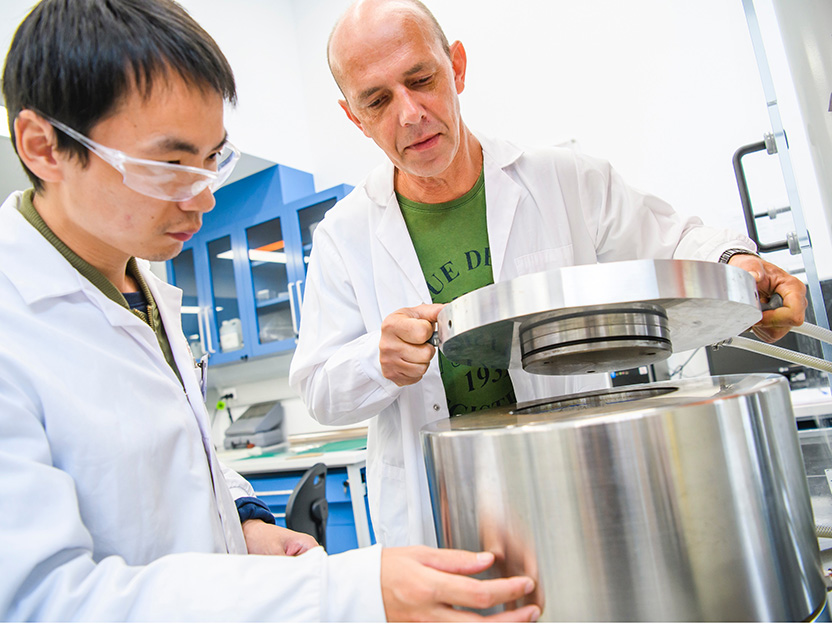
Drs Chunfei Chen and Slava Shcheka conducting a high-pressure experiment.
Analysis of the experimental products with scanning electron microscopy at Macquarie University, and an electron microprobe at Microscopy Australia’s ANU facility revealed the chemical changes that occur when the rocks and melt interact. This allowed the team to work out the processes occurring in the Earth’s mantle deep beneath the cratons.
Prof. Foley explained that the relatively young carbonate-bearing volcanic rocks formed by this process appear in linear arrangements around the old cratons and provide new and exciting targets for mineral exploration. Currently, most known deposits are found in much older rocks but most of those have already been discovered.
Potential new sources of critical minerals will be of significant economic importance as we move towards achieving Net Zero. There are many sites in Australia, particularly in WA and NT with the geology described above that could be explored for critical minerals to enhance our sovereign capability and potential export markets.
C. Chen et al., Nature 2025
DOI: 10.1038/s41586-024-08316-w
Correction DOI: 10.1038/s41586-025-08911-5
May 20, 2025