Current lithium-ion batteries, while widely used, are expensive and rely on limited resources. Aqueous zinc–iodine batteries – made from materials abundant in the earth – offer a promising, safer, and more sustainable alternative, but they currently have limited performance.
Researchers at the University of Adelaide, led by Prof. Shizhang Qiao, have made a breakthrough in zinc–iodine battery technology. They developed a scalable ‘dry electrode’ fabrication method that significantly enhances battery performance. This innovation allows for much higher energy capacity, surpassing previous zinc–iodine batteries. The dry method also creates a dense electrode, reducing energy loss and improving stability.
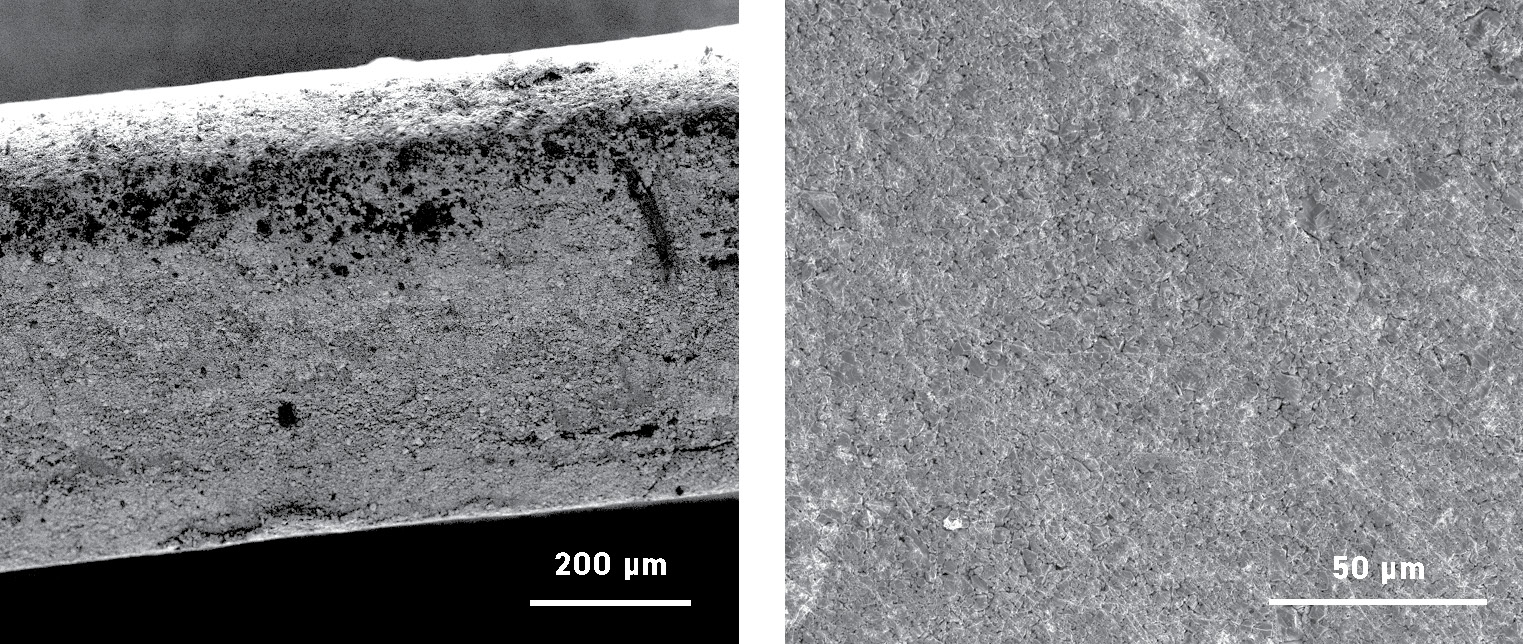
Left: Cross-section of the dry electrode, imaged using scanning electron microscopy.
Right: Surface structure of the dry electrode imaged using scanning electron microscopy
To further boost battery life, the team also introduced a simple chemical, 1,3,5-trioxane. This additive forms a flexible protective film on the zinc anode, preventing dendrites: sharp, needle-like structures that can short-circuit the battery and degrade its performance.
These advances enabled a pouch cell delivering twice the charge per unit of surface area – or areal capacity – of conventional lithium-ion batteries, while retaining 88.6% of its capacity after 750 cycles. This is a significant step towards reliable, low-cost, grid-scale energy storage. Importantly, this dry-processing technique is adaptable to other battery chemistries, broadening its impact.
This research was supported by Microscopy Australia through Adelaide Microscopy’s advanced instruments and expertise, which allowed the researchers to closely examine the physical characteristics of battery components. This direct observation revealed that dry-processed electrodes were smoother, denser, and free of voids and cracks compared to their wet-processed counterparts – all important for their performance. Researchers also used microscopy to investigate the formation and stability of the protective film on the zinc surface. These insights were crucial for validating the breakthrough and accelerating the development of next-generation energy storage technologies for Australia.
H. Wu et al., Joule 2025
DOI: 10.1016/j.joule.2025.102000
May 5, 2026