Meteorites usually consist of material formed within our solar system but may contain presolar grains formed by stars that existed long before our sun. These particles are identifiable by their unique elemental composition, particularly the ratios of isotopes (elements with differing numbers of neutrons).
Analysis of the particle using atom probe tomography at our Curtin linked laboratory revealed an unprecedented magnesium isotope ratio, the highest ever recorded. This exceptionally high ratio indicates that the particle came from a recently discovered type of star – a hydrogen-burning supernova. Further analysis using NanoSIMS at our University of Western Australia facility found the isotopic signature of oxygen was consistent with the particle having originated outside of our solar system.
“It is simply amazing to be able to link atomic-scale measurements in the lab to a recently discovered type of star” – Prof. Phil Bland, co-author.
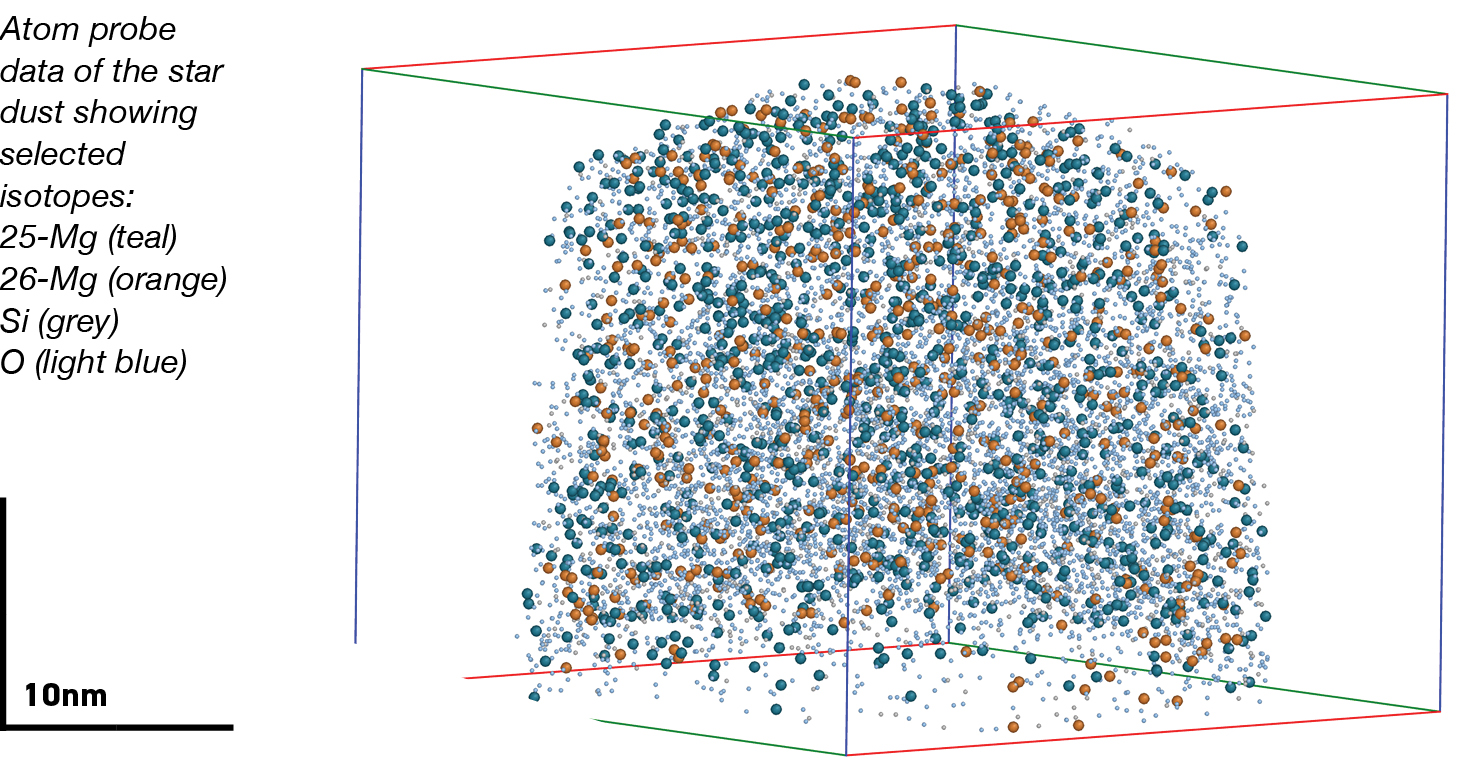
“A hydrogen-burning supernova is a type of star that has only been discovered recently, around the same time as we were analysing the tiny dust particle. The use of the atom probe in this study, gives a new level of detail helping us understand how these stars formed,” said Geoscience Atom Probe expert and co-author Dr David Saxey.
The research challenges existing stellar models and provides essential insights into the evolution of our solar system and the universe at large.
N. Nevill et al., The Astrophysical Journal 2024
DOI: 10.3847/1538-4357/ad2996
January 4, 2025