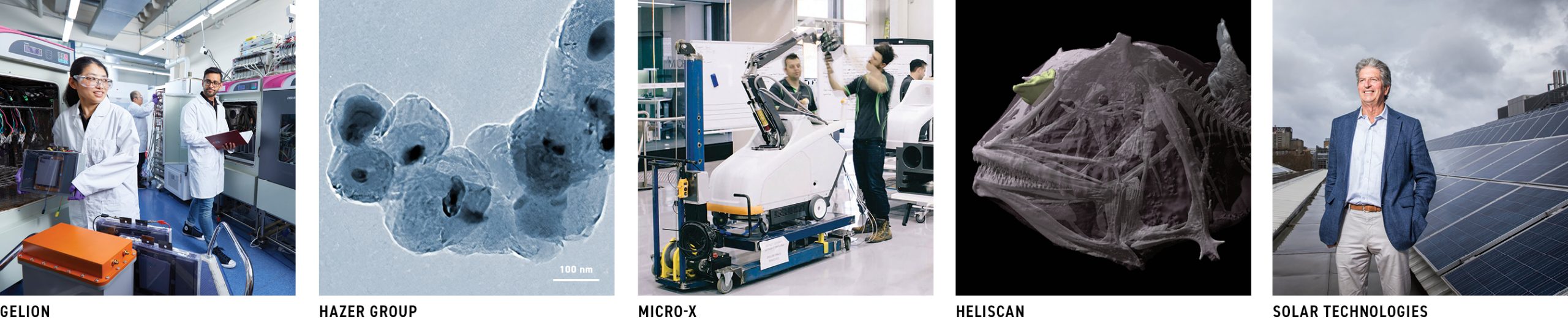
Microscopy Australia has supported renewable-energy storage firm Gelion as they’ve developed their innovative and safe Endure™ energy storage system.
Endure batteries use abundant, inexpensive, recyclable, non-toxic materials to make abuse-tolerant batteries. This makes them ideal stationary storage to provide grid stability for wind and solar energy farms. They will also have applications for large-scale commercial and industrial customers.
They have recently partnered with Sydney-based, lead-acid battery maker, Battery Energy Power Solutions to make Gelion’s batteries in Australia. They have also signed an MOU with Mayur Renewables in Papua New Guinea, to supply 100MWh of energy storage over the next five years. Coupled with large-scale solar energy this could provide remote PNG communities with an affordable, renewable and robust solution for their energy needs.
Spun out of UWA in 2010 and listed on the ASX, Hazer Group is commercialising their low-emission process to convert methane into hydrogen and graphite.
Microscopy was fundamental in the technology development stage of this work. In 2020, after a successful feasibility study, Hazer attracted A$9.4 million in government funding and partnered with the WA state government to convert methane from wastewater into fuel-grade hydrogen and graphite.
The company has now signed an MOU with FortisBC and Suncor Energy to develop a hydrogen production facility in Canada. Suncor and FortisBC will have exclusive rights to deploy the Hazer Process™ in Canada and Colorado, USA, in return for a royalty payment scheme. The feasibility study began in February 2022, with a target date for final investment decision by 2023, and operations commencing in 2025.
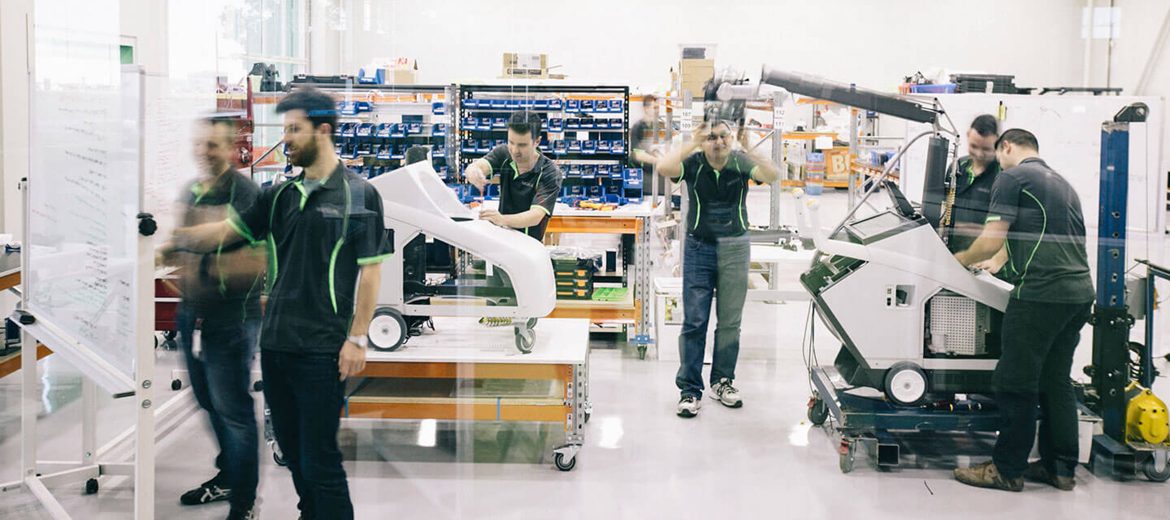
Micro-X has developed and patented an innovative X-ray emitter that uses carbon nanotubes (CNTs). The use of CNTs is the key to reducing size, weight, heat and power for truly portable X-ray machines.
This award-winning CNT emitter is the basis of Micro-X’s portable X-ray machines, which are manufactured in Adelaide. These machines are now installed in an increasing number of Australian and international hospitals. Their development was supported by both Microscopy Australia and Australian National Fabrication Facility.
Micro-X are also developing portable brain scanners for ambulances and aircraft, small baggage scanners for airports and an IED-detecting X-ray camera for military use.
Research collaborators at the Australian National University (ANU) and UNSW Sydney developed and patented a new type of X-ray micro-CT instrument and analysis system called the Heliscan™.
This award-winning intellectual property has supported industry sectors from large energy and mining, aerospace and medical devices to important Australian museum collections. Microscopy Australia enabled the development of this technology.
This success led to their spin-out company Digitalcore, formed in 2009, providing rock analysis for the global oil and gas industry. The company was sold for A$76 million to Thermo Fisher Scientific (formerly FEI) in 2014. The Heliscan is now commercially available to the international imaging community. While the technology has been sold, the instruments and expertise still reside at Microscopy Australia’s ANU facility.
Prof. Martin Green, Director of the Australian Centre for Advanced Photovoltaics (ACAP), with its headquarters at UNSW Sydney, developed the Passivated Emitter and Rear Cell solar technology back in 1983. This technology was the basis for 91% of worldwide silicon solar module production in 2021.
His research group has held the record for silicon solar cell efficiency for 30 of the last 39 years. He and the ACAP researchers continue to build on this success. Prof. Green is the first Australian to win the prestigious Millennium Technology Prize for transforming the production of solar energy. His large team and collaborators are developing a range of new types of solar cells to push efficiency boundaries, make use of easily available materials and improve recyclability. Microscopy Australia has been supporting this work since our inception. One example of this is ACAP researcher Prof. Xiaojing Hao’s innovative kesterite solar cells. Read more on page 32.
December 4, 2022