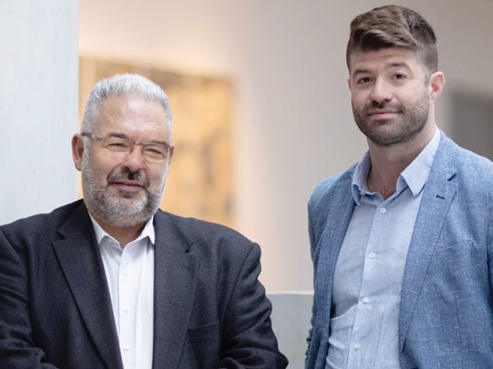
Kinoxis founders Prof. Michael Kassiou and A/Prof. Michael Bowen.
Kinoxis Therapeutics is an Australian spin-out company developing KNX100: a drug candidate to treat substance use disorders, and agitation and aggression in dementia.
Our University of Sydney facility was used to help develop the drug and understand how it works in the brain. Kinoxis has received grants totalling over US$6M million from the US National Institutes of Health to support the development of KNX100, including the recently completed phase 1 clinical trial. In 2021 Kinoxis Chief Scientific Officer, A/Prof Michael Bowen was recognised with the New Innovators award at the Prime Minister’s Prizes for Science for the development of KNX100.
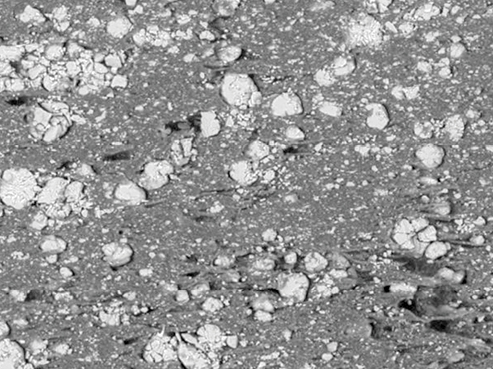
Aluminium cladding imaged using scanning electron microscopy.
In the wake of the Grenfell Tower fire, the Australian construction industry wrestles with assessing the flammability of aluminium composite panel cladding on Australian buildings.
Staff of the Microscopy Australia facility at the University of Queensland have developed a method that uses scanning electron microscopy to identify flame retardants and analyse the flammability of different cladding. They are applying this method to help clients across the industry make informed choices and create safer buildings.
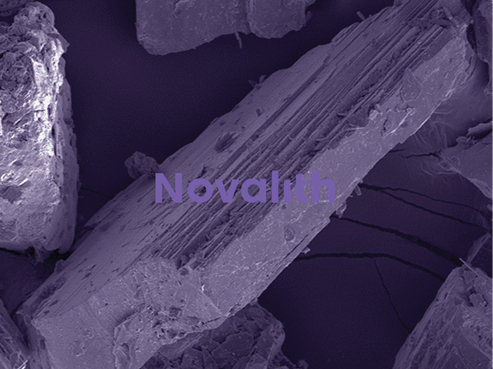
Lithium crystals imaged using scanning electron microscopy.
Spun out of the University of Sydney, Novalith is commercialising their low-cost, sustainable process to convert lithium bearing ores to battery grade lithium chemicals. Microscopy Australia’s UNSW facility, and our industry subsidy, was fundamental in the development of this technology.
After a successful feasibility study and demonstrations at lab scale, Novalith attracted ~US$15 million in Venture Capital funding. The company has since started the construction of their Pilot Plant Facility in Alexandria, Sydney. The Pilot Plant is expected to be running at real-world scale producing kilograms of lithium chemicals per day by 2024.
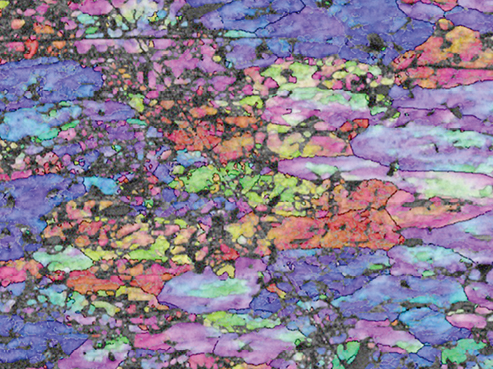
Grain structure of sheet metal imaged visualised using EBSD.
A client in the packaging industry had been encountering unpredictable failures in the metal sheeting from one of its two suppliers.
Our University of Sydney facility conducted analysis to examine the grain structure of the two products. They discovered that the product that was failing was not meeting the required specifications, which accounted for the observed failures. The packaging company was then able to present these findings to the suppliers who admitted their shortcomings, saving time and money for our client.
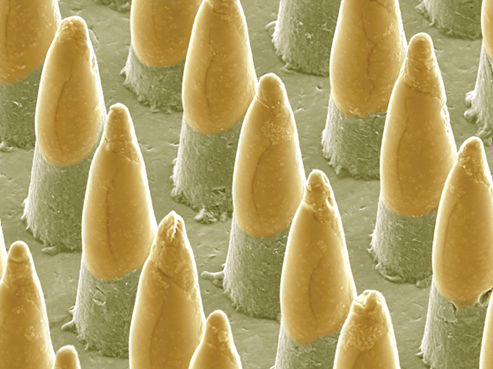
Vaxxas, a spin-out company commercialising a needle-free vaccine patch, the HD-MAP, used our facility at the University of Queensland throughout the technology’s development, and continues to access our facilities for ongoing clinical and pre-clinical trials.
Vaxxas recently opened a 5,500m2 first-of-its-kind manufacturing site to support the scale-up of the HD-MAP production for late-stage clinical trials and first commercial products. Vaxxas’ R&D and manufacturing teams are working side-by-side to streamline the translation of research to commercialisation. The company plans to expand to over
200 employees in the coming years.
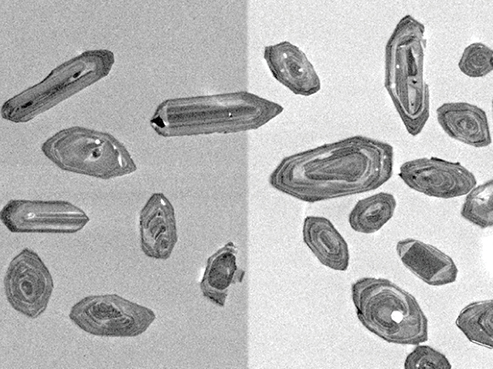
Cathodoluminesence image of zircon grains.
A mining client needed to identify the age of a rock package to update geological models and better target rock units of interest.
Our University of Western Australia facility conducted U–Pb dating on zircon grains from two intrusive rock samples. The dating of these samples improved the understanding of when the gold deposit formed and provided further insights into its structure. The mining company was then able to use these findings to better target their gold mining activities.
December 4, 2023