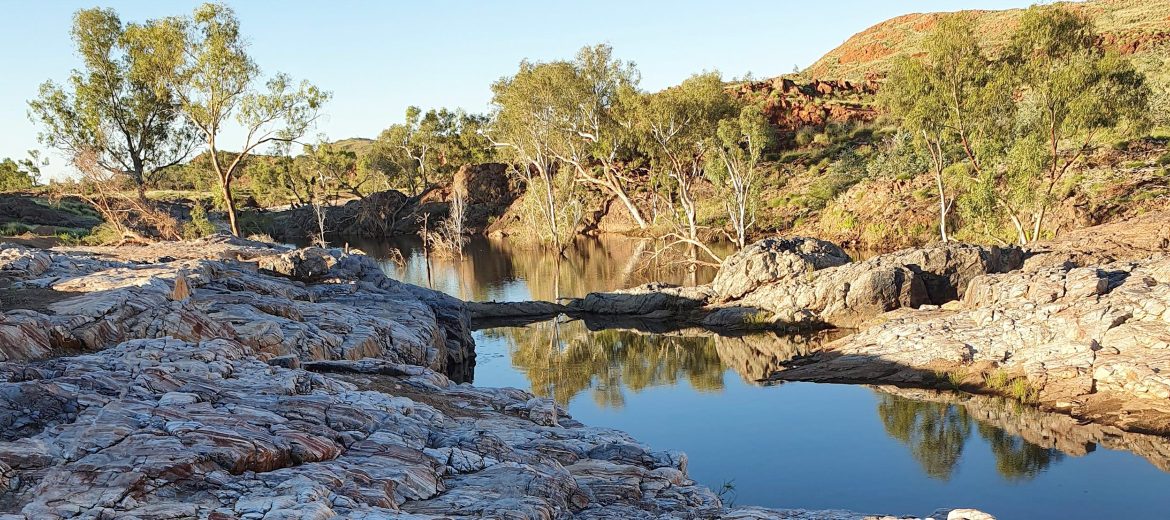
The Pilbara region in Western Australia contains some of the world’s oldest rock formations and fossils, providing an ideal window into early Earth. These rocks contain trapped oily organic compounds, some as old as 3.48 billion years. Many believe they are fossilised remnants of early microbial life, potentially the precursors of all life. However, a ground-breaking study challenges this view.
Led by A/Prof. Birger Rasmussen and Dr Janet Muhling from UWA, the research suggests that these carbon compounds were not from fossils at all. Using high-resolution microscopy and microanalysis at Microscopy Australia’s UWA facility, the team found the carbon was likely to be from an oily solution that had migrated into the rock rather than from fossilised bacteria.
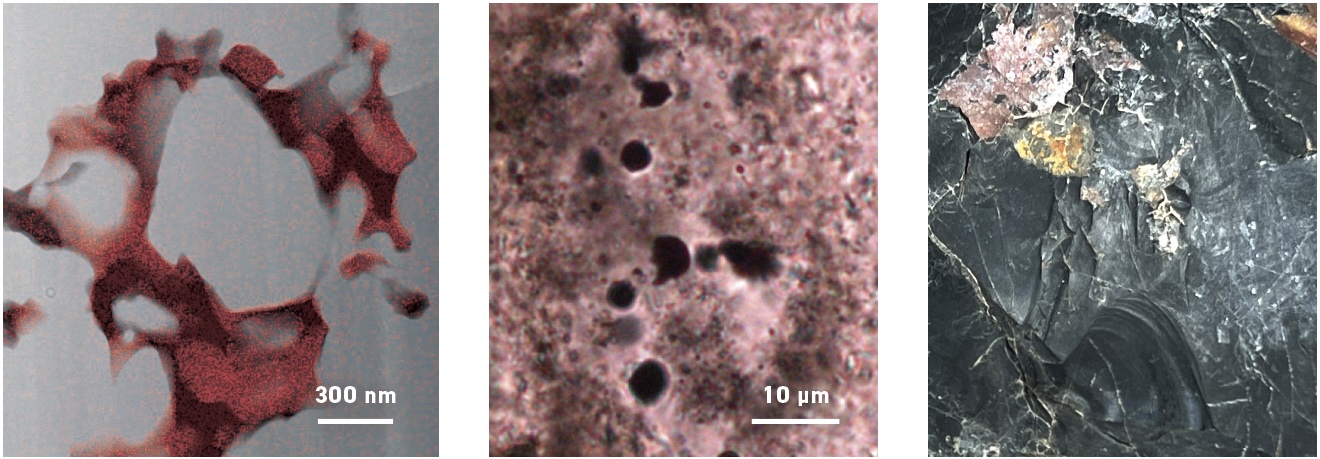
Left: Elemental map of carbon (red) overlaid on a transmission electron micrograph of the organic compounds by Dr Janet Muhling. Centre: the 3.5 billion year old fossilised oil droplets. Right: a sample of the rock, a chert, in which the oil was found by A/Prof. Birger Rasmussen.
They posit that as seawater interacted with lava on the ocean floor, the water and carbon dioxide could react with mineral surfaces to form organic compounds. These fluids could have then moved through the rock, crystalising into ‘oily biomorph’ structures resembling fossils. While not ruling out a biological origin entirely, the lack of typical mineral indicators for fossils in these rocks raises questions.
Beyond Earth, the study also sheds light on Mars. Meteorites from the red planet contain similar organic carbon compounds, hinting at comparable chemical processes in Mars’ early oceans. The findings highlight potential parallel paths that researchers should consider when investigating development of life on Earth and Mars.
This discovery challenges the idea that carbon unequivocally equals life and adds essential pieces to the puzzle of life’s origins.
B. Rasmussen et al., Science Adv. 2023
DOI: 10.1126/sciadv.add7925
Photo of the study site near Marble Bar, Western Australia, by Steve Sheppard.
December 4, 2023