The COVID-19 pandemic underscored a critical global need: the ability to develop and deploy effective vaccines at unprecedented speed to contain emerging infectious diseases. Traditional vaccine development timelines – often measured in years – are too slow to respond to fast-moving outbreaks.
In 2019, the Coalition for Epidemic Preparedness Innovations (CEPI) recognised the potential of UQ’s Molecular Clamp vaccine platform and funded researchers at The University of Queensland (UQ) to help achieve this goal by addressing a key scientific hurdle: how to stabilise viral proteins so they can be used to quickly and reliably create vaccines. Outside of pandemics, the technology was licensed to Vicebio a start-up created by UniQuest and Swiss/UK venture capital investor Medicxi to progress the technology for a range of vaccines.
Led by Professors Paul Young, Keith Chappell, and Daniel Watterson, the team had developed the Molecular Clamp, a tiny protein-based ‘clamp’ that locks viral proteins into their original shape. This stabilisation enables vaccines to accurately mimic the virus and trigger a strong immune response. Crucially, it also allows scientists to design vaccines in record time, as demonstrated when the UQ team created a COVID-19 vaccine candidate just 34 days after the SARS-CoV-2 virus’s genetic code was released – an extraordinary achievement.
Australia’s National Research Infrastructure played a role in enabling this research through two NCRIS Providers: Microscopy Australia and Therapeutic Innovation Australia (TIA).
Cryo-electron microscopy at Microscopy Australia’s UQ facility, the Centre for Microscopy & Microanalysis, was critical to this breakthrough, being used throughout the process to confirm the structures of ‘clamped’ viral proteins. It enabled the researchers to visualise the structures at near-atomic resolution and confirm they retained their original form, giving confidence to the effectiveness of the resulting vaccine. The team continues to use these facilities in the development of new vaccines.
TIA enabled successful proof of concept by manufacturing a SARS-CoV-2 vaccine candidate at National Biologics Facility and CSIRO Biomedical Manufacturing for two Phase I clinical trials.
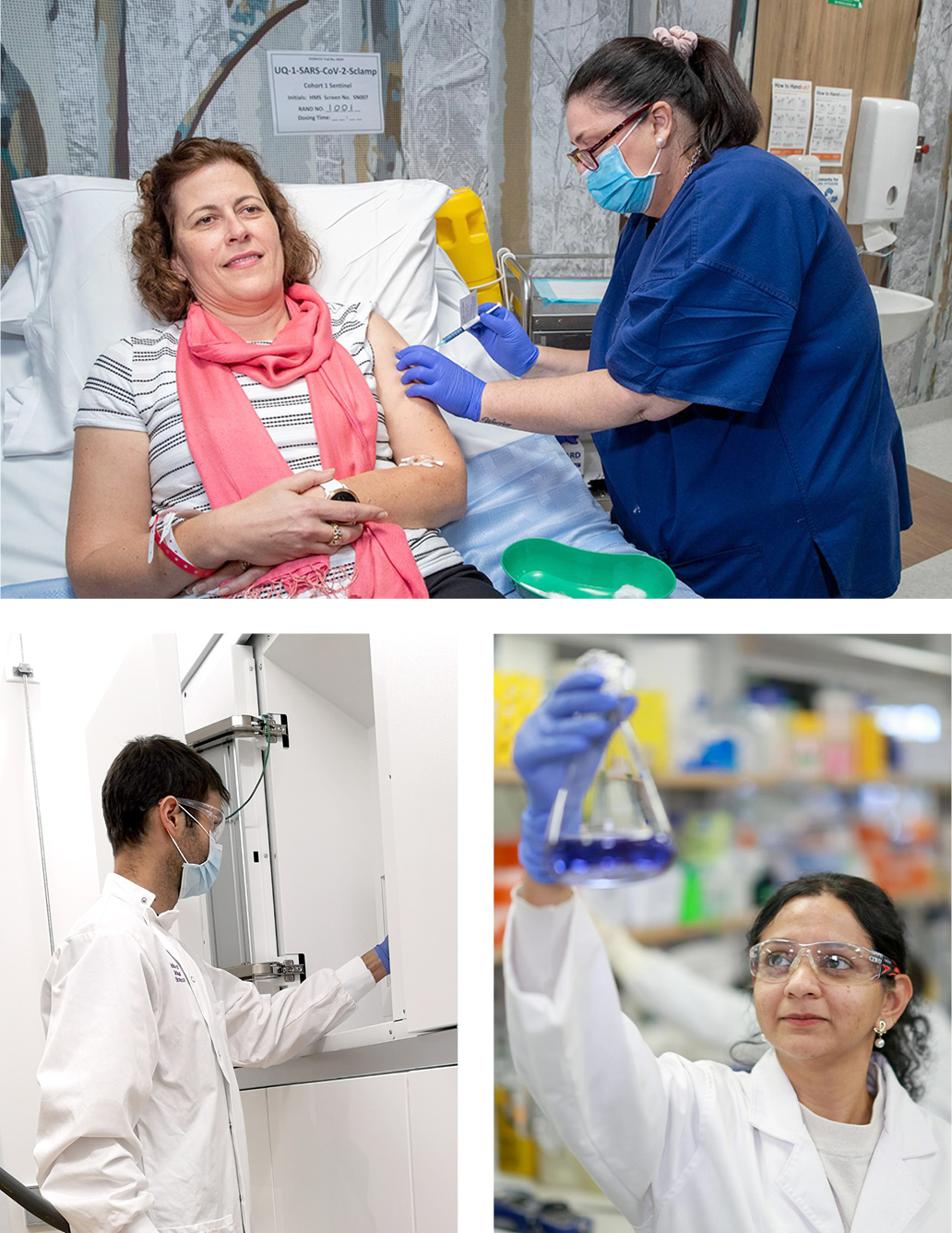
Top: Participants in a clinical study receive the vaccine candidate for COVID-19 in 2020. Credit: UQ.
Lower left: Expert microscopist Dr Lou Brillault with the Cryo-Electron Microscope at CMM, UQ. Lower right: Sharada Kolekar in the Chappell Group Lab, AIBN, UQ. Photo credit: UQ.
Although their initial COVID-19 vaccine showed strong protection in early trials, it triggered false positives in some HIV tests due to the HIV-derived sequences used in the clamp. While not harmful, this diagnostic interference limited its global rollout.
While CEPI funded UQ to develop the Molecular Clamp platform for pandemic preparedness, use outside of pandemics was licensed to Vicebio, which ran in stealth mode before and during the COVID-19 pandemic. The company developed Clamp2, a second-generation version of Molecular Clamp that resolves the diagnostic issue while retaining the original benefits, and progressed a bivalent vaccine into clinic trials – against respiratory syncytial virus (RSV) and for human metapneumovirus (hMPV) – helped with a Series B capital raise of US$100 million in 2024.
The success of Molecular Clamp has led to a historic commercialisation deal: global healthcare leader Sanofi is acquiring Vicebio for AU$1.7 billion (US$1.15 billion), with milestone payments of up to AU$690 million (US $450 million). The acquisition brings a clinical stage combination RSV/hMPV vaccine candidate into Sanofi’s pipeline and expands its respiratory vaccine portfolio with a non-mRNA option.
As part of CEPI’s mission to develop a vaccine within 100 days of a new threat, the UQ team has recently tested Clamp2’s rapid-response potential by developing a vaccine for the rare Bolivian Chapare virus. They’re also working on broad-spectrum vaccines for virus families like Henipaviruses, which includes Hendra, aiming for single shots that protect against multiple diseases.
May 5, 2026