Found at McGraths Flats, these fossils are exceptionally well preserved in a type of iron-rich rock called goethite. This kind of fossil preservation is rare and has revealed more about Australia’s prehistoric freshwater rainforest environments.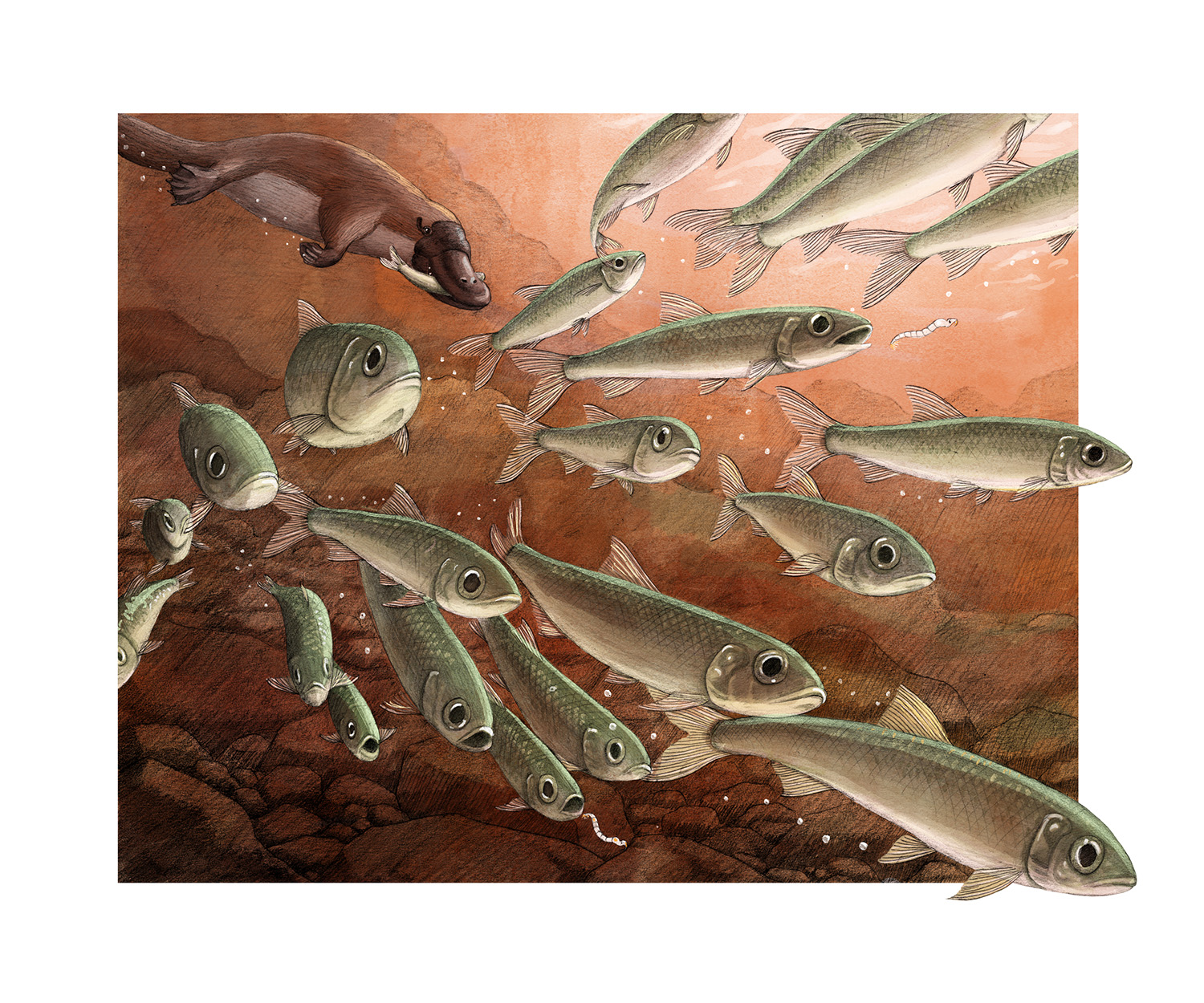 Thanks to this exceptional preservation, the team led by Dr Matthew McCurry (Australian Museum) and A/Prof. Michael Frese (University of Canberra) was able to determine the stomach contents of several specimens – midge larvae, winged insects, and small shellfish – a similar diet to its modern relatives. Even more extraordinary, they were able to reconstruct the original colour pattern. The fish had a darker back, a pale belly, and two stripes along its sides. One of the fish also had a parasitic freshwater mussel larva, called a glochidium, attached to its tail. Glochidia attach themselves to fish to travel through river systems, suggesting that the body of water at McGrath Flats may once have been connected to a larger river network.
“Using a powerful microscope, we were able to see tiny colour-producing structures known as melanosomes. Fossilised melanosomes have previously enabled palaeontologists to reconstruct the colour of feathers, but melanosomes have never been used to reconstruct the colour pattern of a long extinct fish species,” said A/Prof. Frese.
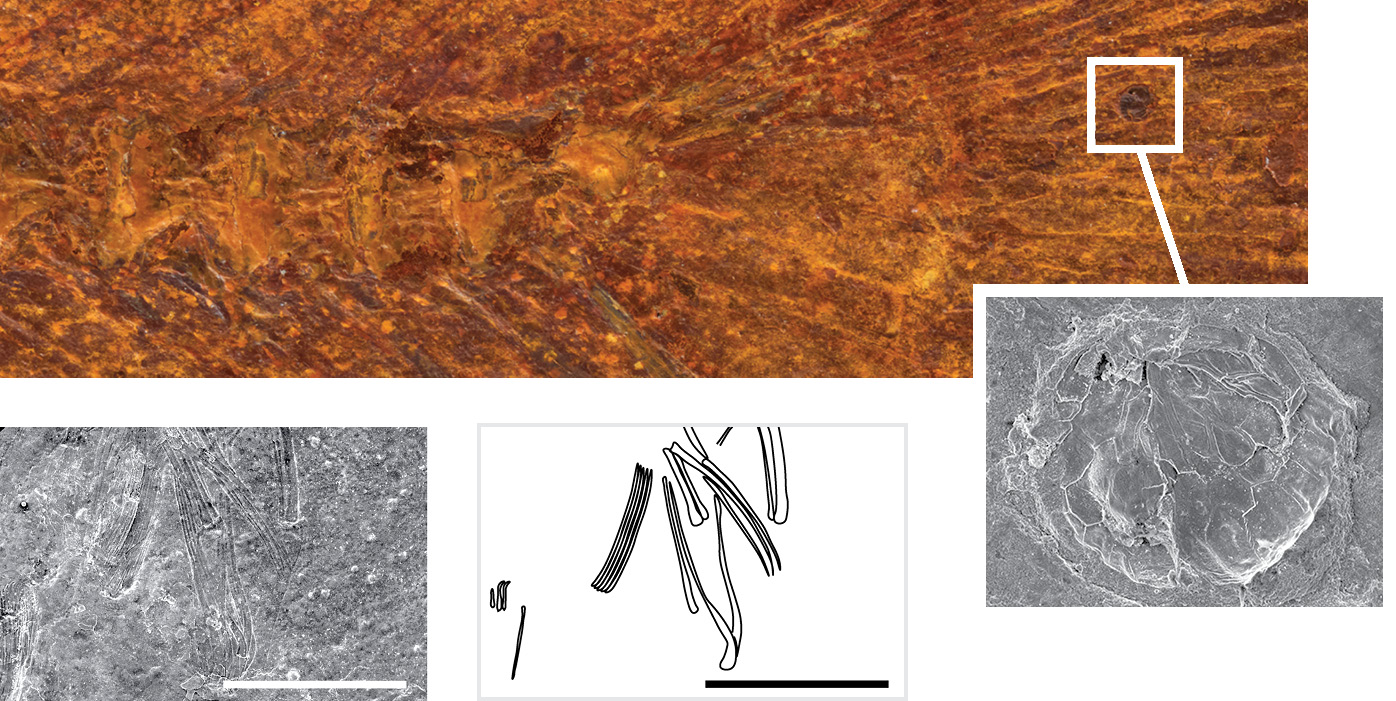
Upper image and zoom in: A parasitic freshwater mussel larva attached to the tail of one of the fossil fish.
Lower two images: Stomach contents of the fish showing parts of a midge. Scale bar equals 400 μm.
This research was made possible through access to microscopes at the Centre for Advanced Microscopy at the Australian National University, a Microscopy Australia facility. Using scanning electron microscopy and light microscopy, the team uncovered otherwise invisible microscopic details, revealing the species’ colour pattern, identifying parasites, and analysing its diet and feeding behaviour.
These details provide a rare glimpse into the diet and habitat of ancient freshwater species related to today’s Australian grayling and smelt, and also highlights the critical role of microscopy in unlocking Australia’s prehistoric past.
M. McCurry et al., Vertebrate Paleontology 2024
DOI: 10.1080/02724634.2024.2445684
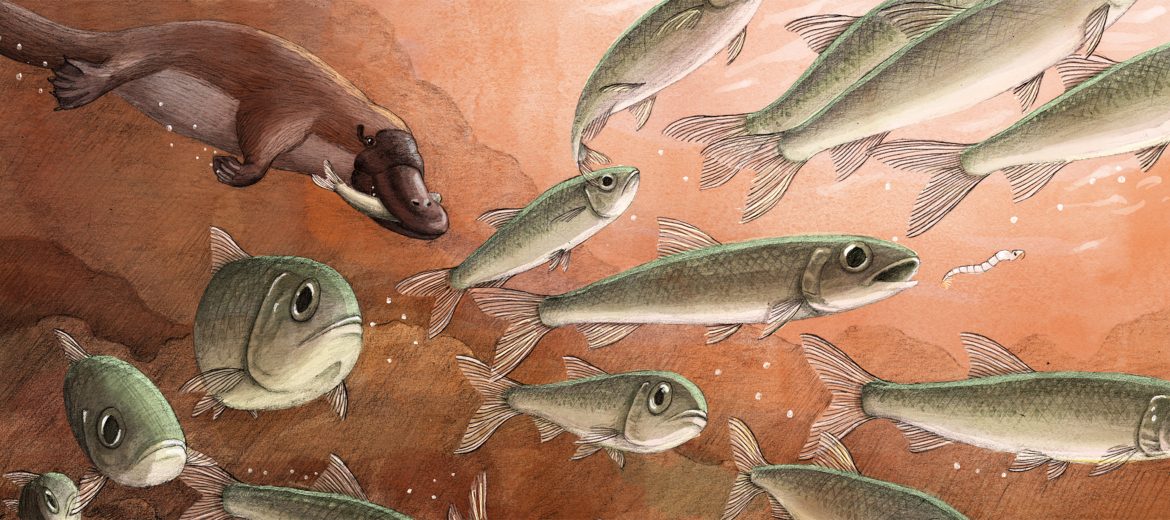
A school of Ferruaspis brocksi is feeding on larvae of the phantom midge Chaoborus abundans while being chased by Obdurodon, an extinct toothed platypus © Alex Boersma
May 5, 2026