A new study led by an international team, including researchers from The University of Western Australia (UWA), has discovered that the microscopic sea creatures have unique characteristics that make them an excellent, long-term recorder of environmental conditions. The organisms are a type of foraminifera called Textularia agglutinans. They build a shell around themselves made of sand grains embedded in a calcium carbonate inner shell. The team discovered that the composition of this inner calcium carbonate layer changes depending on the temperature of the water in which the animal grows.
In warmer water more magnesium gets incorporated into the inner shell. Dr Aleksey Sadekov and Dr Hua Li from our UWA facility were part of the research team and used high-sensitivity analytical tools to measure the magnesium. They were able to detect even small changes in levels resulting from just a few degrees of temperature change. They also measured other elements such as lead, zinc and manganese as these provide a record of pollution from human activity. Their measurements were very consistent, providing excellent reference data for future comparisons.
T. agglutinans lives in shallow coastal waters down to about 120 metres and has existed for more than 100 million years. This is longer than many other types of foraminifera used to measure ocean temperature, which makes this species ideal for connecting present-day coastal observations with deep-time climate history. By measuring magnesium levels in ancient, fossil T. agglutinans, researchers can reconstruct ocean temperatures at different time periods – from recent centuries back to the early Cretaceous period.
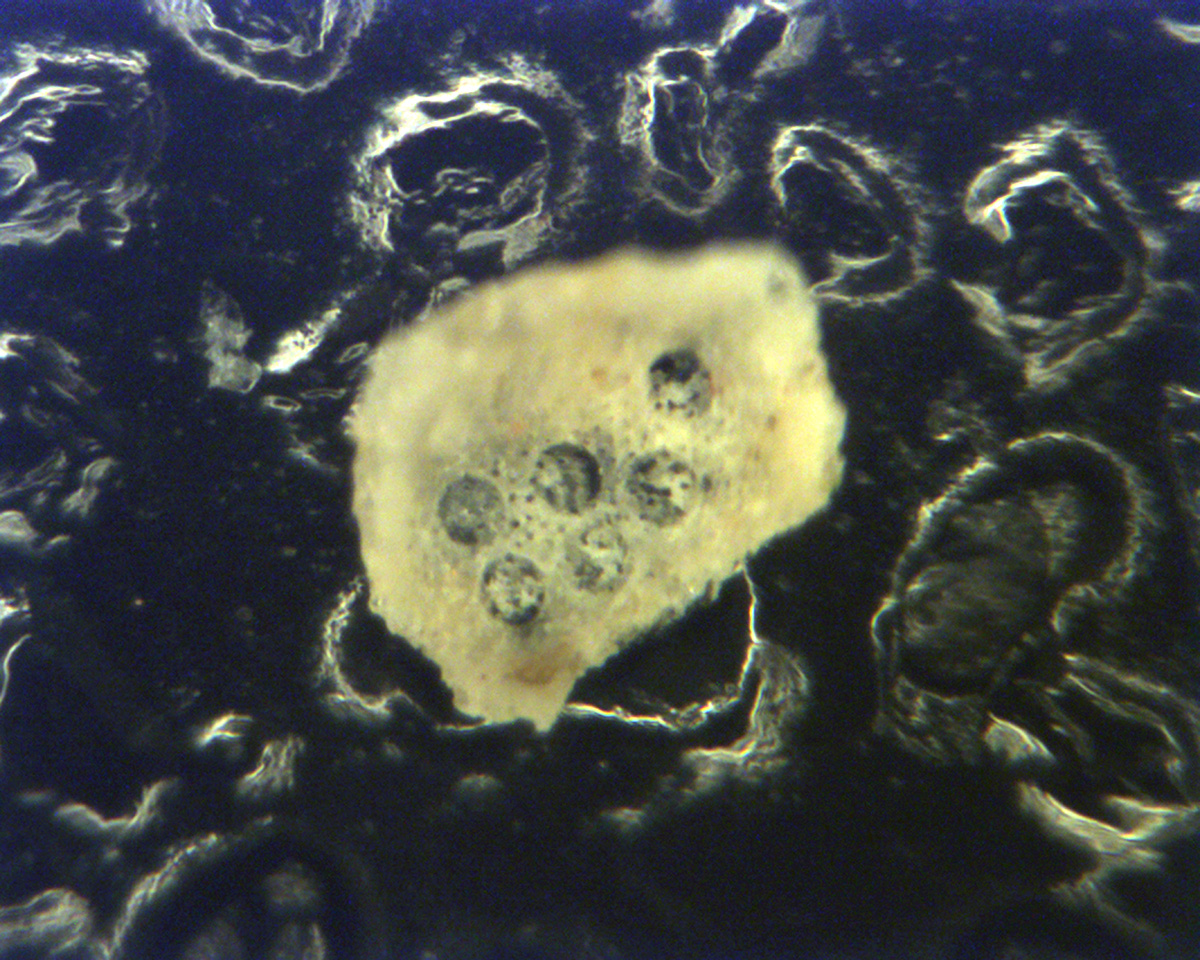
Light microscopy image of a piece of the inner shell of a T. agglutinans showing the locations (large holes) analysed for elemental composition.
T. Sosnitsky et al., PNAS 2025
DOI: 10.1073/pnas.2413054122
May 5, 2026