They find new applications along with new ways of configuring microscopes, capturing data from them, and analysing that data – here are just a few of their recent achievements in data analysis.
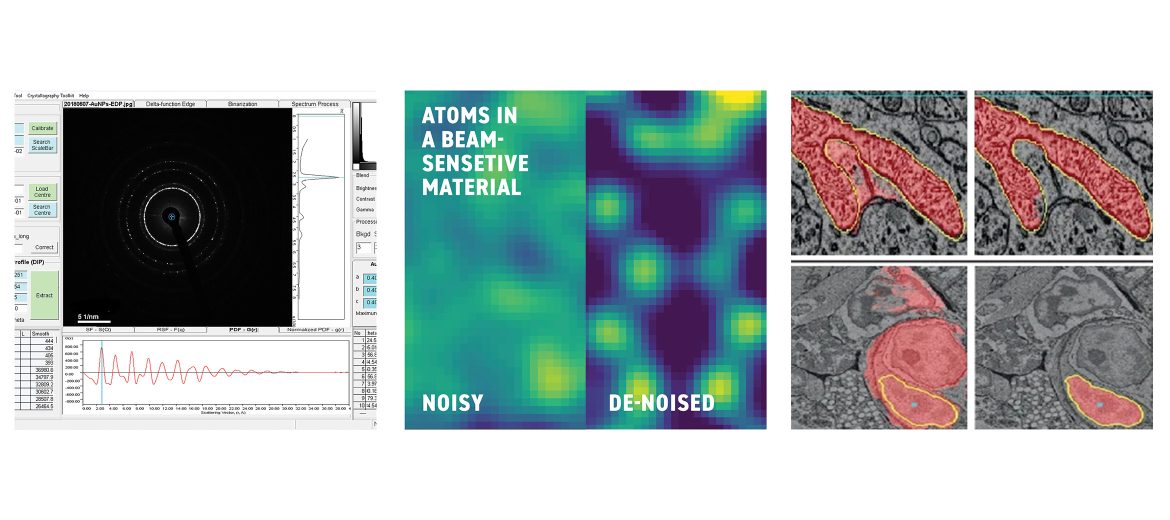
 Electron diffraction data made easy
Electron diffraction patterns collected in the transmission electron microscope (TEM) hold a wealth of information. Now scientists at our University of Sydney facility have developed a new software tool (EDP2PDF) to analyse these diffraction patterns more effectively. Their tool overcomes existing challenges encountered when using other methods and provides a much easier way for researchers to understand atomic structures of crystalline and non-crystalline materials. This is now being used by the global TEM community.
 AI helping TO MAKE THE UNSEEN SEEN
AI and advanced direct electron detectors are making it possible to image beam-sensitive materials that were previously almost impossible to visualise. These new detectors capture weak, noisy signals from the materials, while AI tools, developed in collaboration with our Monash facility, are used to ‘de-noise’ the data. These materials are critical for green energy technologies like batteries and solar cells, and for emerging quantum applications.
 DEEp LEARNING TO SPEED UP SEGMENTATION
Segmentation – highlighting features in microscopy images – is slow when done manually. Developed with input from a Microscopy Australia expert, Segment Anything for Microscopy (μSAM), uses deep learning to segment and track multidimensional microscopy data. Built on the Segment Anything model, it is designed to improve segmentation quality for a wide range of imaging conditions, laying the groundwork for solving complex image analysis tasks in microscopy with a small set of powerful deep-learning models.
May 5, 2026