By studying the archaeological record, researchers at the Australian National University and UNSW Sydney, led by Dr Ben Shaw, have found clues to discovering new sites of early Lapita occupation on islands off southern Papua New Guinea.
One of these islands revealed human occupation from 4,400 years ago. In the oldest layer they found volcanic glass for tools that originated from an island 300km away, and in slightly younger layers (3,480–3,060 years ago) dog and pig bones: animals only ever found in Lapita sites. Distinctive pottery has previously been used to identify Lapita sites but this was not found in the older layers of the dig, although it was found in younger layers representing periods of more sustained Lapita settlement (from 2,500 years ago) .
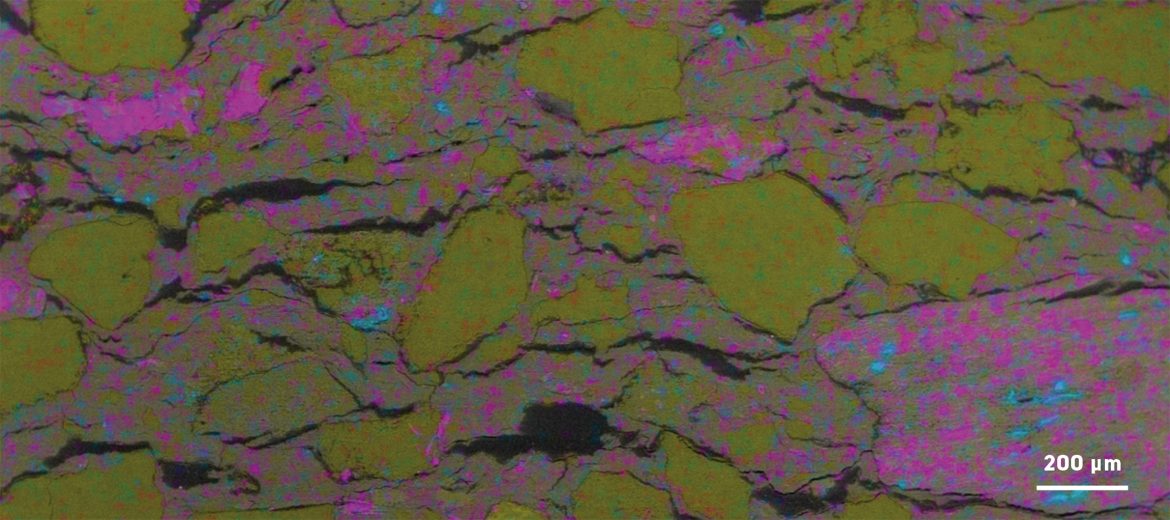
Microanalysis at Microscopy Australia’s UNSW Sydney facility was used by co-author, Dr Karen Privat, to determine the composition of this early Lapita pottery. Dr Privat found that some of the pottery was made locally and some on nearby islands that had not previously been identified as Lapita sites. This shows both that Lapita potters very quickly adapted to using high quality local clay sources and that this sustained Lapita settlement was supported by a network of Lapita communities on surrounding islands, which can be identified by the minerals used to make the pots. These sites will be investigated soon.
B. Shaw et al., Nature Ecology & Evolution 2022
DOI: 10.1038/s41559-022-01735-w
Elemental analysis of one of the pottery fragments showing silicon in green, iron in pink and titanium in blue. This provided a mineral signature that allowed the source of the clay to be identified.
December 4, 2023