The ‘tandem’ solar cells are created by stacking a perovskite cell – made from a family of materials with a specific crystal structure – on top of a silicon cell. Together they absorb a much wider spectrum of light, producing significantly more energy from sunlight than each individual device could alone. The team achieved an efficiency of 30.3% – meaning 30.3% of sunlight is converted into energy. In comparison, commercial silicon solar cells have an efficiency of around 20%. The new technology builds on work which the team has published in Nature, Science and Advanced Energy materials over the last three years.
Their new technique not only improves efficiency but enhances the operational stability of the solar cells. “Surpassing the 30% mark is significant,” said lead author Dr The Duong. “That’s currently considered the efficiency threshold for the commercialisation of tandem technology like that used in our study.” The researchers also say the solar cells are easier to manufacture as they use a standard fabrication technique, applied to a new material.
The achievement also meets the first of three 2030 ‘stretch goals’ set by the Australian government in 2021 under its ‘Solar 30 30 30’ target, aiming to reach 30% module efficiency and 30 cents per installed watt at utility scale by 2030.
“The current predictions are that tandem solar technology will be in mass production by 2026. However, more work is still needed to upscale and ensure the technology can be stable in the field over 25 to 30 years,” said Dr Duong.
Microscopy Australia’s Australian National University facility has been supporting Prof. Kylie Catchpole’s research team and the development of these solar cells for over a decade.
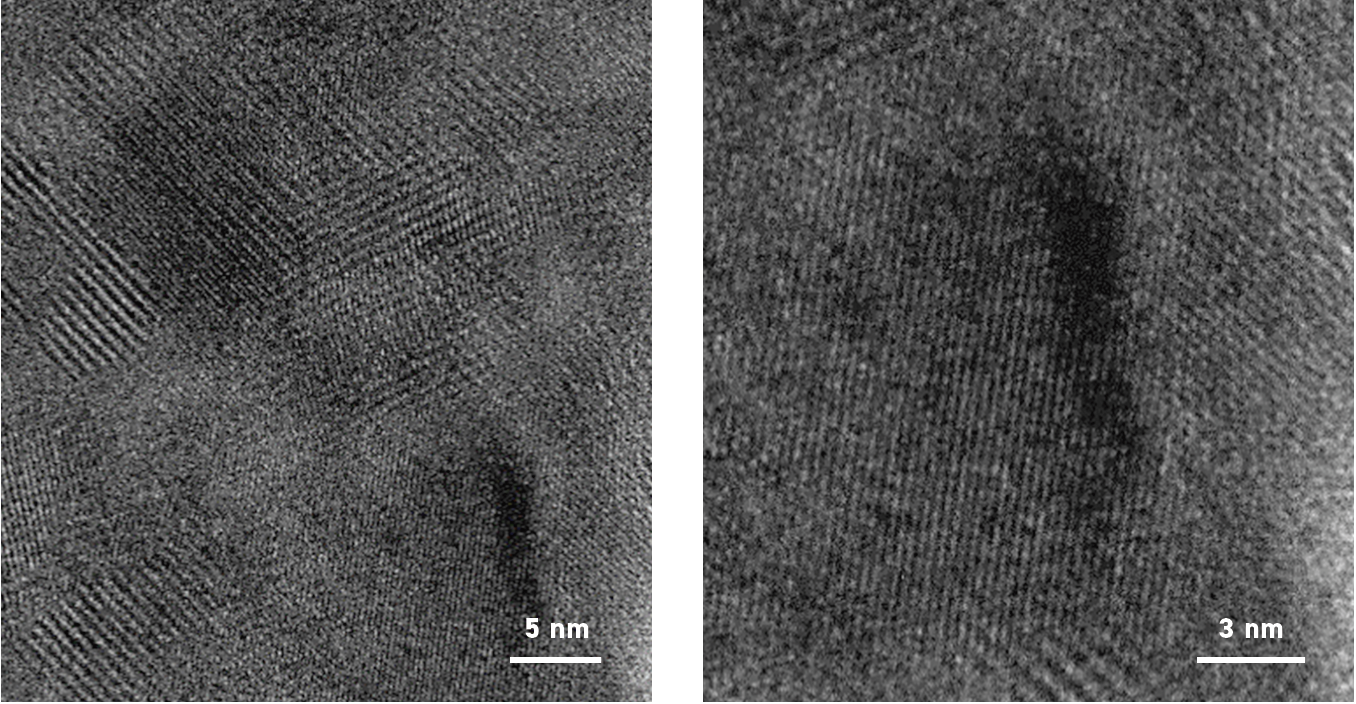
Atomic scale transmission electron microscope images demonstrating two different atomic structures of perovskite (2D left, 3D right). The lines in these images are rows of atoms in the perovskite structure.
The team is now working to further improve the efficiency and stability of the solar cells.
The work has been financially supported by ARENA through the Australian Centre for Advanced Photovoltaics.
T. Duong et al., Adv. Energy materials 2023
DOI: 10.1002/aenm.202203607
J. Peng et al., Nature 2022
DOI: 10.1038/s41586-021-04216-5
J. Peng et al., Science 2021
DOI: 10.1126/science.abb8687
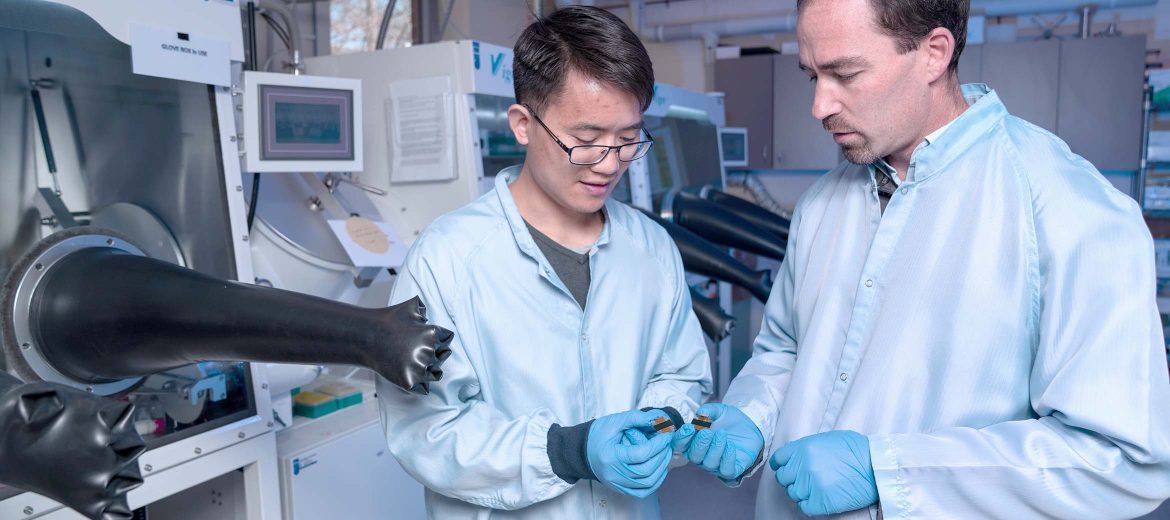
Dr Jun Peng and A/Prof. Tom White from the ANU with their record breaking perovskite solar cells (Lannon Harley/ANU).
December 4, 2023