Ammonia is the second most-produced chemical globally, and its use in fertiliser feeds half of the world’s population. However, current production methods are energy intensive, accounting for 1% of greenhouse gas emissions and consuming 2% of global energy. Despite this fact, ammonia is an efficient way to store renewable energy.
A number of approaches to greener ammonia production are being developed with the help of our microscopy, and their commercialisation has the potential to revolutionise this critical global industry.
Microscopy Australia’s University of Sydney, UNSW Sydney and Monash facilities were essential to the development of several innovative green ammonia technologies.
UNSW Sydney researchers Prof. Rose Amal, a green ammonia expert, and Prof. Xiaojing Hao, a solar expert, have collaborated to develop a new method for producing green ammonia. It uses a specially designed and adapted solar panel that works like an artificial leaf using sunlight to turn nitrate-containing wastewater into ammonium nitrate for fertiliser. Unlike traditional methods, this system works under ambient conditions. It depends on a very efficient nanostructured catalyst made of copper and cobalt hydroxide incorporated into a traditional silicon solar panel. Prof. Amal is now seeking industry partners to further develop the process into a fully viable commercial system.
In our 2021 Research Highlights we reported on the energy-efficient plasma reactor that Prof. Amal also contributed to. It generates nitrites and nitrates, which are then converted to ammonia by copper nanowire catalysts. This process is now being commercialised by NSW spin-out PlasmaLeap. They have now scaled up production rates to make their process economically viable.
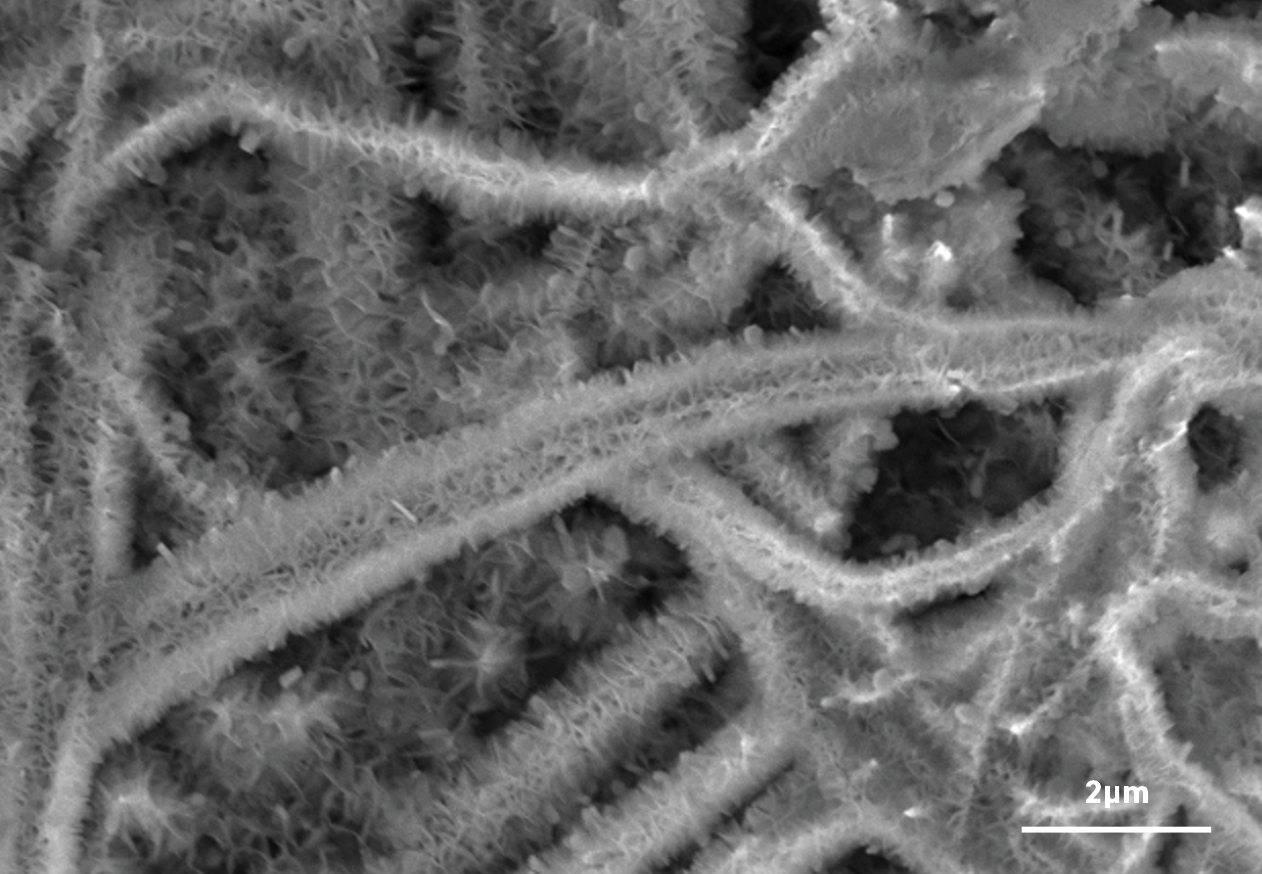
Scanning electron microscopy (SEM) image showing the network of the cobalt-coated copper nanowires.
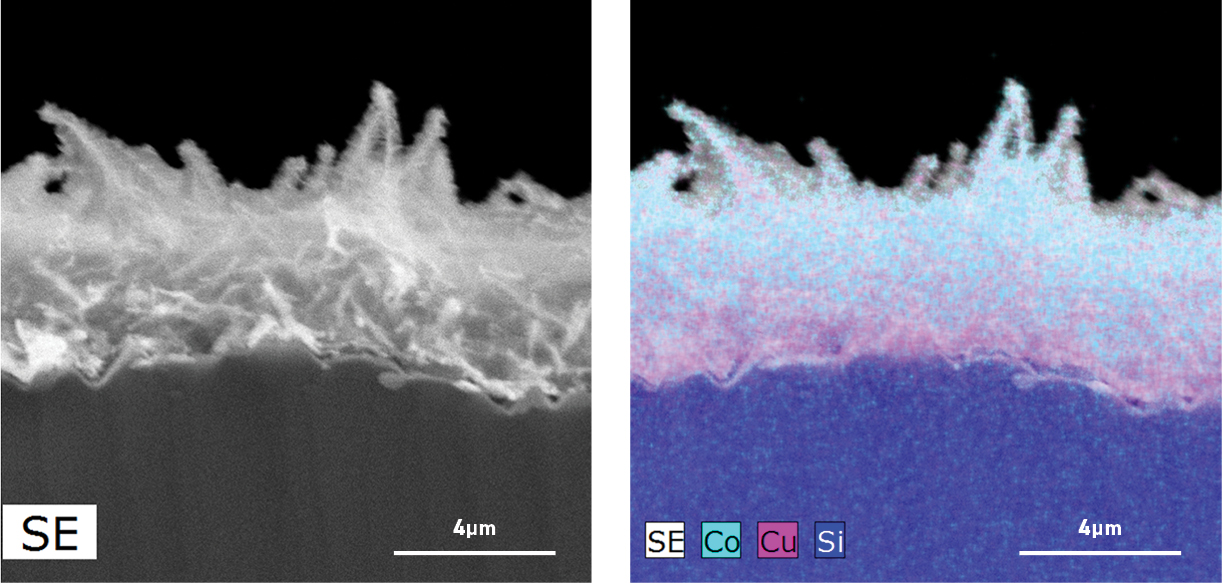
Left: SEM of a cross section of one of the nanowires. Right: Elemental mapping of the same part of nanowire showing the cobalt (Co) coating on the underlying copper (Cu) and silicon (Si).
Another emerging approach, covered in our 2022 Research Highlights, developed at Monash University uses just air, water, and renewable energy in a patented electrochemical process that rearranges nitrogen and water atoms to produce ammonia. The process is being commercialised by Jupiter Ionics who recently raised $9M in series A funding for the scale up of their self-contained system.
All three of these approaches can be implemented on-site in agricultural locations, decentralising the production process, reducing CO2 emissions from transport and eliminating the need for large scale storage and the risk of explosion that comes with it.
Both large and small scale green ammonia production will allow:
C. Han et al., Energy & Environmental Science 2024
DOI 10.1039/D3EE03836J
January 4, 2025