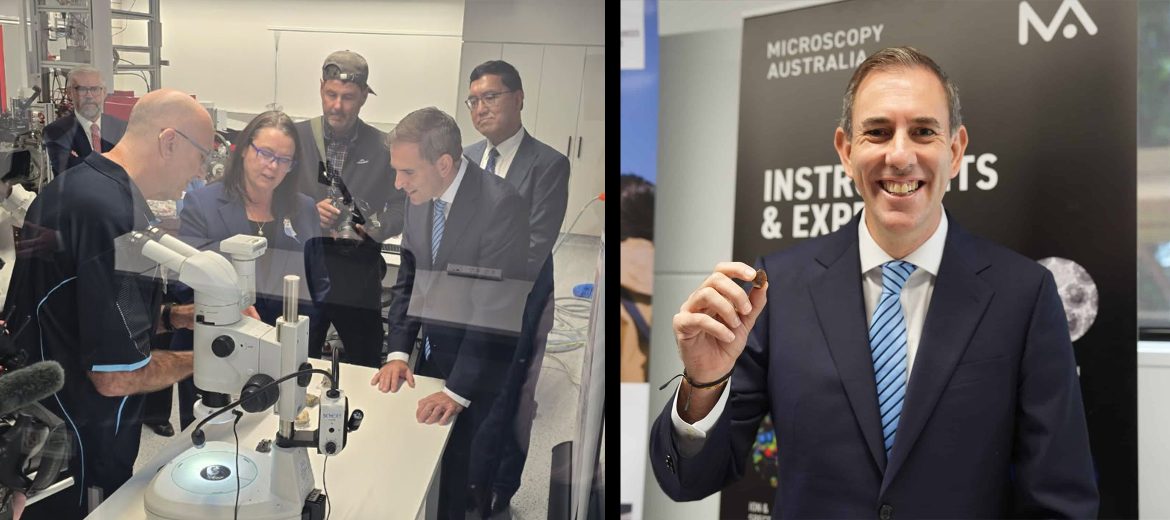
The visit formed part of a broader press conference announcing federal support for the Arafura Nolans rare earths project, underscoring the central role of scientific research and advanced infrastructure in strengthening Australia’s position in global critical minerals supply chains.
Prof. Tony Kemp and Dr Paul Guagliardo introduced the Ministers to rare earth element–rich minerals and demonstrated how researchers use the NanoSIMS facility at CMCA to analyse the composition of those minerals at the nanoscale. This approach reveals what he describes as the “DNA of minerals”, helping scientists understand how mineral systems form and behave, providing the knowledge required to improve extraction, processing, and recovery of critical resources.
The ARC Training Centre in Critical Resources for the Future is developing the next generation of geoscientists to address growing global demand for critical minerals, with expertise spanning the full value chain from discovery to processing. Microscopy Australia plays a key role in supporting one of its four research themes, ‘Accelerating Characterisation’, providing access to advanced microanalytical tools and microscopes that reveal how critical minerals are distributed and behave within ores, and along the processing stream. This insight is essential for improving the efficiency and sustainability of mineral extraction and processing.
What is less visible in moments like this is the national investment that underpins these capabilities. Facilities such as those within Microscopy Australia are supported through the Australian Government’s National Collaborative Research Infrastructure Strategy (NCRIS), with additional support from states and universities. This coordinated model enables access to highly specialised infrastructure and expertise that would be beyond the reach of any single institution.
Sustained, long-term support for national research infrastructure is critical to maintaining these capabilities and the skilled workforce behind them. From advanced microscopy to supercomputing and astronomy, NCRIS-funded infrastructure plays an essential role in Australia’s research and innovation system, connecting discovery to application and supporting national priorities such as critical minerals.
June 24, 2026